What Is Market Sentiment? (And How Crypto Traders Use It)
fomoMay 20, 2026

~5-minute read · Beginner to Intermediate
In crypto, prices often start moving before the headlines land. A single tweet can send a memecoin soaring. A wave of panic can erase billions overnight. Behind every one of these swings is something every trader needs to understand: market sentiment.
If you've ever bought into a rally because everyone else was buying—or panic-sold because your timeline was filled with doom—you've experienced sentiment firsthand. The difference between reacting to it and reading it is what separates impulsive traders from informed ones.
This guide explains what market sentiment is, why it's especially powerful in crypto, and the indicators traders actually use to measure and trade it.
TL;DR
Market sentiment is the collective mood of traders toward a market or asset—bullish, bearish, or somewhere in between. In crypto, sentiment moves prices faster and more dramatically than in traditional markets. This guide covers the most important sentiment indicators, how crypto traders use them, and common mistakes to avoid.
Market Sentiment, Defined
Market sentiment is the overall attitude of investors and traders toward a specific asset or financial market. It reflects the collective psychology of participants—their expectations, emotions, and beliefs about where prices are heading—and is typically categorized as bullish (optimistic) or bearish (pessimistic).
Unlike fundamental analysis (which evaluates intrinsic value) or technical analysis (which studies price charts), sentiment captures the emotional layer that can drive prices beyond what data alone would predict.
Bullish vs. Bearish Sentiment
| Bullish | Bearish | |
|---|---|---|
| Outlook | Optimistic — prices expected to rise | Pessimistic — prices expected to fall |
| Behavior | Buying, accumulating, going long | Selling, de-risking, going short |
| Indicators | Fear & Greed Index above 60; rising volume on up moves | Fear & Greed Index below 30; rising volume on down moves |
| Risk | Can lead to FOMO-driven bubbles | Can lead to panic selling and undervaluation |
Why Sentiment Hits Harder in Crypto
Sentiment influences every market, but it plays an outsized role in crypto. Volatility amplifies emotion—10–20% daily swings are common. Many tokens (especially memecoins) lack traditional fundamentals, making sentiment the primary price driver. And because crypto markets are global and 24/7, information cascades across X/Twitter, Telegram, and Discord at any hour.
The Key Sentiment Indicators Crypto Traders Use
1. The Crypto Fear and Greed Index
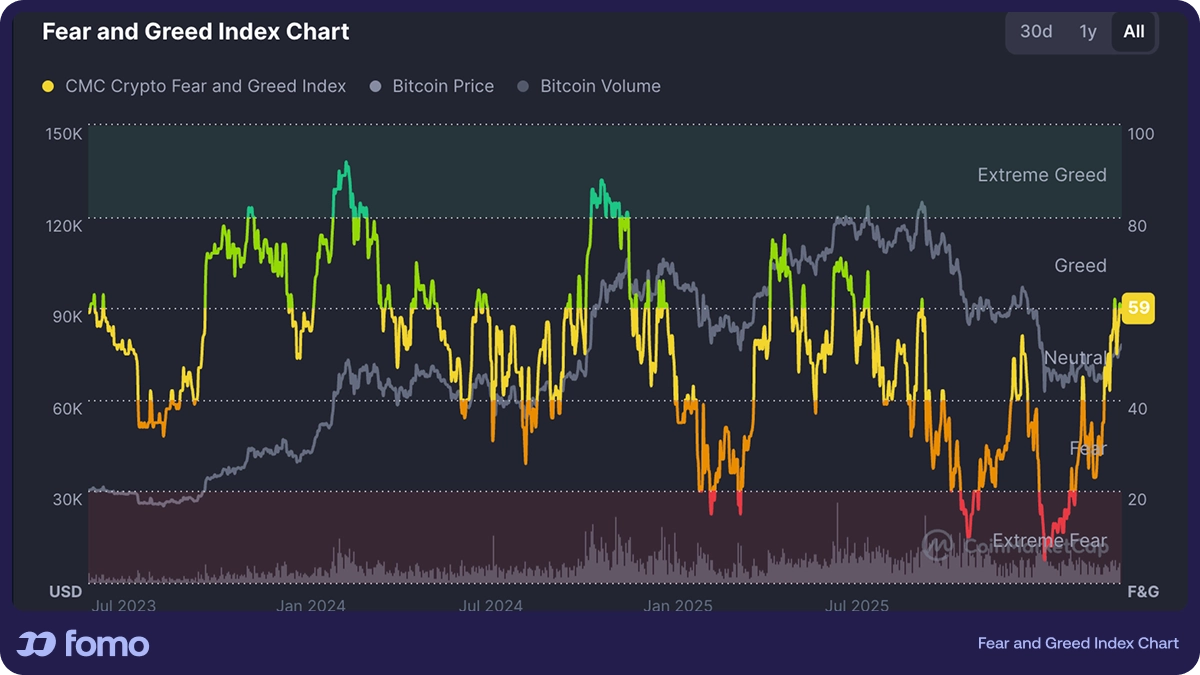
The Fear and Greed Index Chart is the most widely referenced crypto sentiment gauge. It aggregates volatility, market momentum, social media activity, and Bitcoin dominance into a single score from 0 (extreme fear) to 100 (extreme greed).
How traders use it: Readings below 20–25 are often seen as potential buying opportunities. Readings above 75–80 may signal an overheated market ripe for a correction.
2. Social Media Sentiment
Platforms like X/Twitter, Reddit, Telegram, and Discord act as real-time sentiment barometers. Traders track the frequency of mentions for a coin, the tone of those mentions, and how fast buzz is building. A sudden spike in mentions of a small-cap token often coincides with—or precedes—a price move.
But social media hype and genuine conviction aren't the same thing. A trending hashtag with no substantive analysis behind it is a warning sign, not a green light.
3. Trading Volume and Price Action
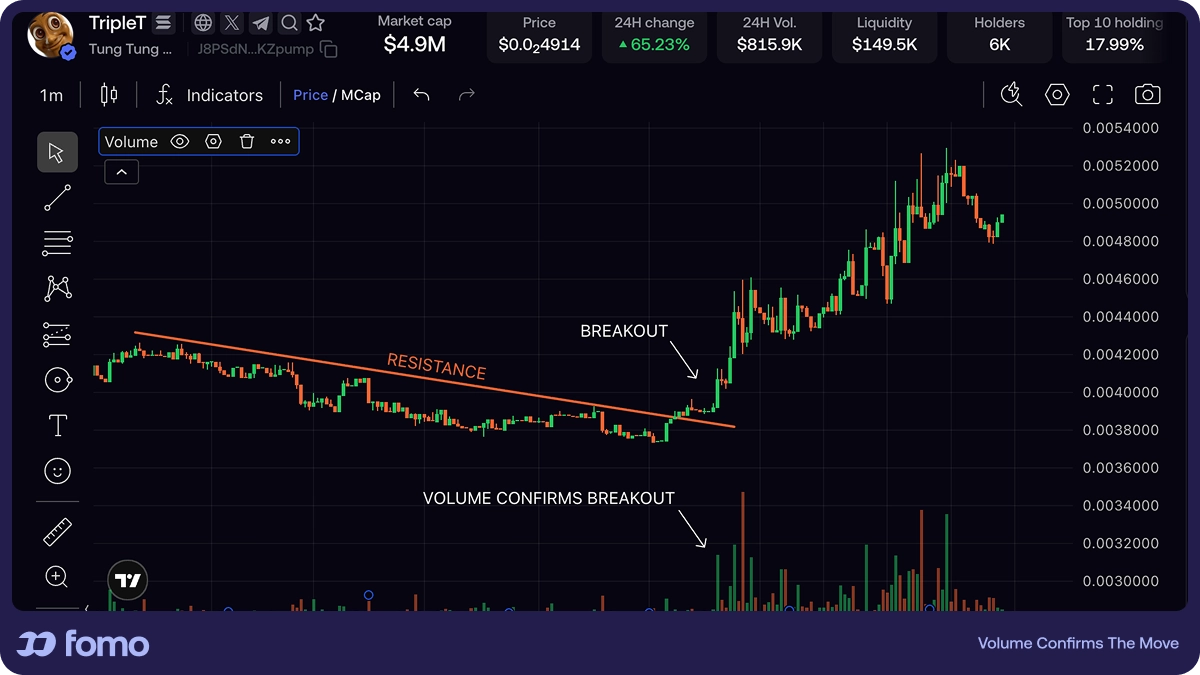
Volume shows how much conviction backs a price move:
- Rising price + rising volume = strong bullish sentiment.
- Falling price + rising volume = panic selling.
- Rising price + low volume = a rally that may lack staying power.
4. On-Chain Data
Because blockchains are transparent, traders can track network activity directly: rising active addresses suggest growing participation, large exchange inflows may signal upcoming sell pressure, and whale movements can shift sentiment in either direction.
5. Funding Rates and Open Interest
In derivatives markets, funding rates reveal positioning. Positive funding means longs are paying shorts (bullish lean); negative funding signals bearish positioning. Open interest spikes show leveraged conviction—or warn of an incoming liquidation cascade.
6. Technical Sentiment Signals
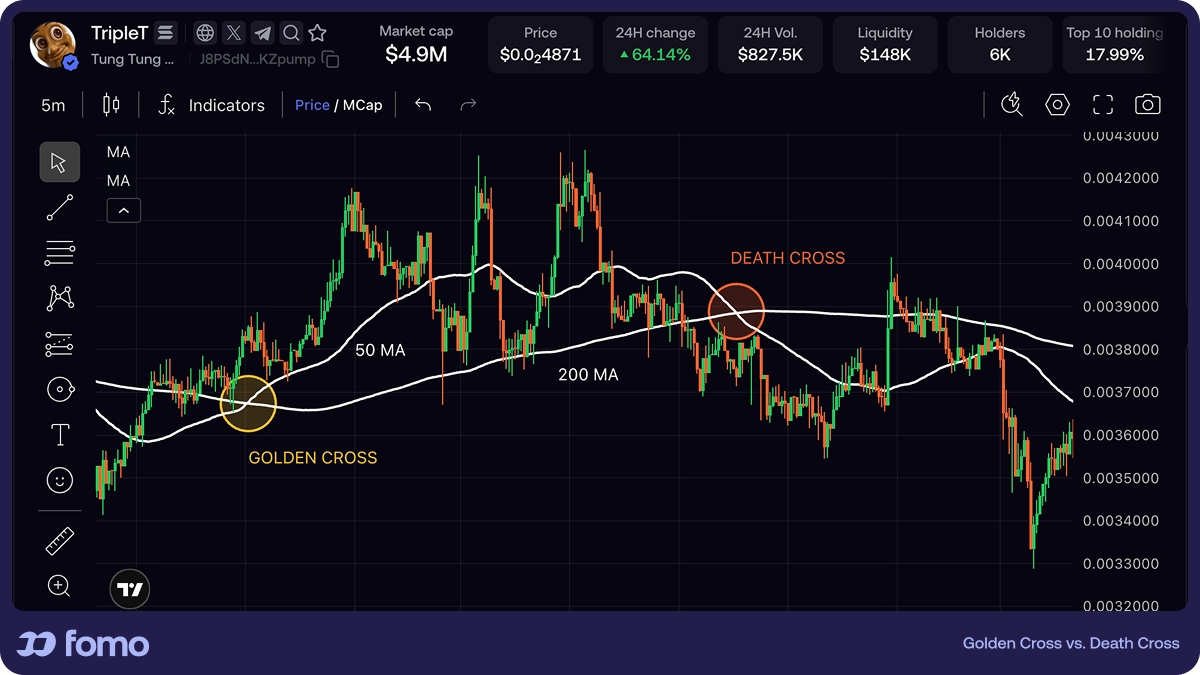
Certain chart patterns serve as sentiment proxies. The golden cross (50-day MA crosses above the 200-day) signals growing optimism. The death cross (the reverse) signals waning confidence. RSI above 70 suggests overbought/greedy conditions; below 30 suggests oversold/fearful conditions.
How Crypto Traders Apply Sentiment Analysis
Trend confirmation
Sentiment works best as a confirmation layer. If charts show a breakout and sentiment indicators agree (rising social buzz, positive funding, Fear & Greed in the greed zone), that's a higher-conviction setup.
Contrarian trading
Some of the best trades happen by going against the crowd at extremes—accumulating during extreme fear, taking profits during euphoria.
Social signal trading
Rather than reading what traders say, modern platforms show what they do. Following the actual buy and sell behavior of top-performing traders provides a behavioral sentiment layer that goes beyond polls and indexes.
On fomo, users can follow top traders and get instant notifications when they buy or sell. Token pages display other traders' buy/sell actions overlaid on the price chart, and coin feeds show every trade and thesis in one timeline—giving you a live, per-token sentiment read. This turns abstract "sentiment" into observable, actionable behavior.
Risk management
During extreme greed, tighten stops and reduce exposure. During extreme fear, start building positions slowly.
| Myth | Fact |
|---|---|
| Sentiment analysis is just guessing | It uses quantifiable data: volume, on-chain metrics, social signals, composite indexes |
| Positive sentiment always means prices go up | Extreme bullishness often precedes corrections |
| You need expensive tools | Free tools like the Fear & Greed Index and social feeds are widely available |
| One indicator is enough | Best results come from triangulating multiple signals |
Common Mistakes to Avoid
1. Relying on one indicator. The Fear & Greed Index is a starting point, not a trade signal.
2. Confusing hype with conviction. A viral tweet isn't the same as smart money flowing in.
3. Ignoring fundamentals and technicals. Sentiment is one lens—use all three.
4. Trading without a plan. Sentiment can flip in minutes. Define your entry, stop, and target before acting.
5. Letting your own bias color your read. If you're already long, you'll naturally filter for bullish signals. Stay objective.
Why fomo Is Built for Sentiment-Driven Trading
Traditional sentiment analysis means checking the Fear & Greed Index on one site, scrolling X for social reads, and visiting another platform for on-chain data. fomo brings key sentiment signals into one app:
- Real-time social feed — see what tokens are moving and what traders are actually buying and selling.
- Follow top traders — get instant notifications on their trades.
- Coin feeds & thesis history — every trade and thesis on a token in one timeline.
- Leaderboards — the most profitable traders across 24h, 7d, and 30d.
- Cross-chain simplicity — trade across Base, Solana, BNB Chain, and Monad from a single app with a unified USD balance.
Key Takeaways
- Market sentiment is the collective mood of traders—ranging from extreme fear to extreme greed.
- In crypto, sentiment moves prices faster than in traditional markets due to 24/7 trading, social media, and speculative assets like memecoins.
- The Crypto Fear & Greed Index is the most popular gauge, but combine it with social data, volume, on-chain metrics, and funding rates.
- Contrarian strategies—buying fear, selling greed—are a classic sentiment play.
- Social trading platforms like fomo let you observe real trader behavior as a live sentiment indicator.
- Never use sentiment in isolation. Combine it with technical and fundamental analysis, and always have a trade plan.
Disclaimer: This article is for educational and informational purposes only and does not constitute financial, investment, or trading advice. Cryptocurrency trading involves significant risk, including the potential loss of your entire investment. Always conduct your own research and consult a qualified financial advisor before making any trading or investment decisions.