Crypto Trading Mistakes: How Satsdats Turned Repeated Blowups Into a Winning Onchain Strategy
fomoFebruary 09, 2026

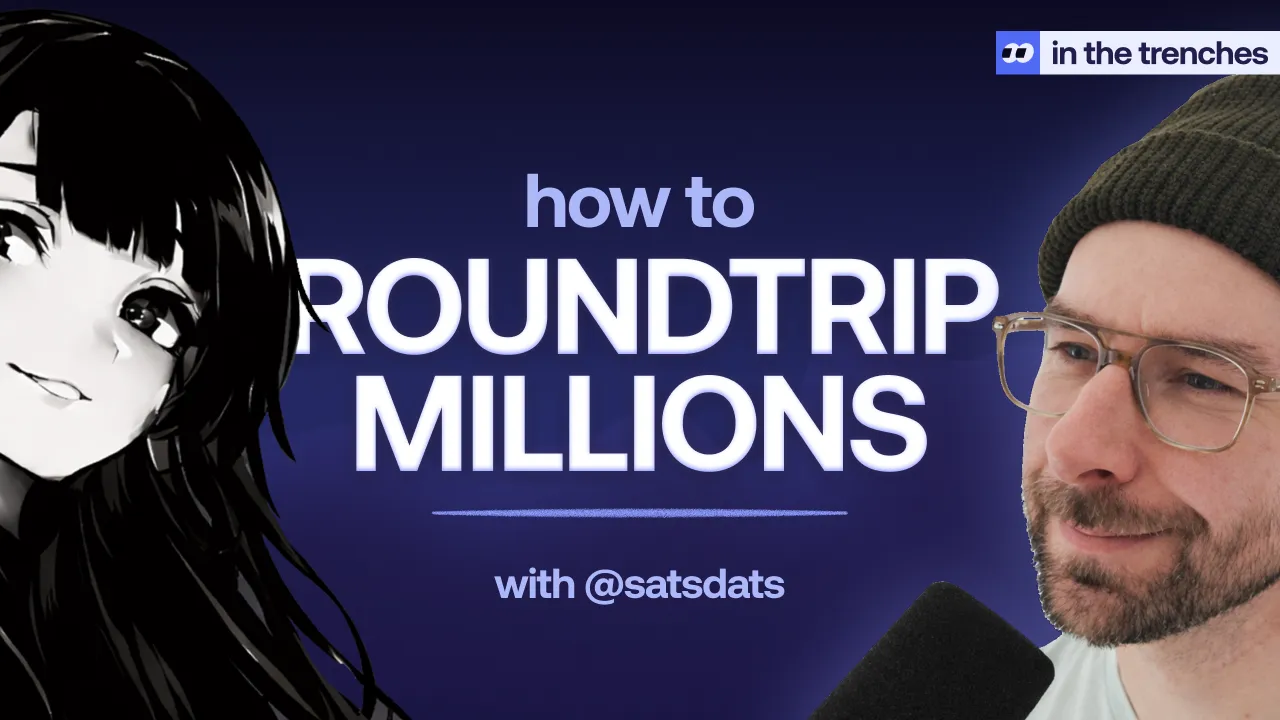
Episode 16 of "In the Trenches" presented by FOMO features an AMA with Satsdats, a crypto trader and co-host of RiskOnPod, who shares his journey from blowing up multiple perps accounts to building a disciplined onchain trading strategy, plus his vision as the new Head of Product at Bonk Fun.
Most crypto traders have a blowup story. Satsdats has three or four of them, each one involving life-changing money that evaporated in a matter of days. But instead of walking away, he rebuilt every single time, eventually pivoting from perpetual futures to onchain trading and learning the brutal lessons that separate consistent winners from chronic round-trippers.
In this deep-dive AMA on the "In the Trenches" podcast, Satsdats pulls back the curtain on how he ran up accounts to seven figures and lost them, what finally changed, and the specific framework he now uses to trade meme coins on Solana. He also discusses his brand-new role as Head of Product at Bonk Fun, where he is working to solve some of the thorniest problems facing crypto launchpads today.
From Perps Blowups to Onchain: A Trader's Origin Story
Satsdats has been in the crypto space for about four to five years. He started as a perpetual futures trader, a world known for its brutal swings and unforgiving leverage. His early career was defined by a pattern that many traders know all too well: spectacular wins followed by devastating losses.
"I ran up a few accounts to life-changing money and lost them probably three or four times over."
His biggest single win came on AXS, the Axie Infinity token, where he built one of his largest perpetual positions ever. Within two weeks of that peak, he blew up just over a million dollars, riding the account all the way back down to zero. He repeated this cycle two or three more times, each time running the account to zero.
But Satsdats does not frame these blowups as pure failure. They were, in his view, the tuition he paid for the lessons that would eventually make him profitable.
"I learned a lot of lessons. It taught me the harsh game which is perp trading... In this space you can make money just as quick as you lose it."
The Pivot That Changed Everything
The turning point came when Base chain launched. Satsdats was one of the earliest users on Base, and he recognized that onchain trading, not perps, was going to be "the future" of crypto speculation. His first major onchain win was Toshi, a token on Base that he entered at sub-100K market cap and watched run to over 200 million.
From there, his trajectory shifted permanently. He bought Popcat sub-1 million market cap and held over 1% of the supply. He was part of the community takeover (CTO) of Shark Cat, buying in at sub-30K and running the project's Twitter account during its explosive growth phase (a stint that, he notes with a laugh, eventually attracted lawsuit threats).
The Psychology of Round-Tripping: Why Traders Give It All Back
One of the most compelling parts of the conversation centers on the mental game. The host pushes Satsdats on what allowed him to break the cycle of running up accounts and then destroying them.
His answer is disarmingly honest: it was his obsession with portfolio all-time highs.
"It's portfolio all-time highs... I had high ceilings, high expectations for myself. I wasn't selling for 50k. I wasn't selling for 100k. I wanted home runs or I wanted nothing."
This "home run or zero" mentality is what drove him to blow up multiple perps accounts. He wanted seven-figure trades or nothing at all. And while that mindset is clearly dangerous, it is also what eventually positioned him to hold winners like Toshi and Popcat for enormous gains, because he was conditioned to hold through volatility and aim for outsized returns.
Does Round-Tripping Ever Stop Hurting?
In a word: no. Satsdats is candid about the emotional toll.
"Round tripping that amount of money is hard. It never won't be hard. It's not like I don't value money. $1,000 is still $1,000 at the end of the day."
The difference between his earlier self and today is not that the losses hurt less. It is that he built systems to prevent them from happening in the first place.
The Fix: How to Stop Giving It All Back
When asked for the single most important lesson from his round-tripping years, Satsdats gives advice that sounds simple but is remarkably hard to execute.
"It's taking money offchain into stable yield farming vaults and forgetting it exists."
The problem, he explains, is that when money stays in your Phantom wallet, it is too easy to click away. You hit a big win, you feel invincible, and instead of stabling any of it, you roll the entire portfolio into the next play. You size up into riskier positions. And then one bad night, something like Ralph goes to zero overnight, and your entire portfolio is wiped.
The Greed Trap
Satsdats describes a psychological phenomenon that every trader encounters as their portfolio grows: money starts to feel like playing chips rather than real dollars.
"You start to lose touch with how much money translates to in the real world. So, you just made 100K in seven days, you can lose 20K and you won't really... you'll be like, 'Ah, you know, I only made 100K this week.' But 100K in the real world is a lot of money."
His prescription? Take some money out and try to spend it in the real world.
"You take 10K and you go wander around and you try and spend it in real life and it's difficult. And it might make you value the money on chain a little bit more, make you realize it's not just playing chips."
Onchain Trading Strategy: Position Sizing, Entries, and Exits
Moving from psychology to mechanics, Satsdats breaks down his actual trading process with surprising specificity.
Position Sizing: Play With What You Can Lose
His approach is straightforward. He loads a fixed dollar amount into his Phantom wallet, currently around 100K, and treats it as money he is willing to lose entirely. This is not his entire net worth. It is a dedicated trading bankroll, with the rest of his capital in stables elsewhere.
"The best traders you will see is because they are comfortable in losing and they can make objective decisions where their portfolio doesn't control their mind. And that is the edge you have over 99% of onchain traders because most people are playing with too much."
This is, he argues, the root cause of virtually every trading mistake: oversizing. When you have too much money on the line, fear takes over. You sell too early. You hold losers hoping for breakeven. You cannot think clearly.
Entry Strategy: No DCA, No Full Stack
Satsdats enters positions in approximately 10K clips. He does not use dollar-cost averaging (DCA) and does not put his entire position on in one shot.
His reasoning against DCA is practical: on Solana, when you create a DCA order, other traders get notified. Someone frontruns the order, blasts the price up 20%, and your average entry ends up much higher than intended.
"I'd rather just get in and kind of raw dog it."
Exit Strategy: EMAs and Momentum
For exits, Satsdats relies on a tool that some traders dismiss as too simple: exponential moving averages (EMAs).
He primarily uses 9-length EMAs on the 1-hour chart. When price loses that EMA, he begins cutting the position. He does not care if the token goes higher after he sells.
"Go on the penguin chart, you put on the hour EMA on a nine length, you'll see what I mean. It gets defended the whole way up. It loses the EMA, you cut."
For higher market cap assets, he uses 200-length EMAs on 4-hour charts. He has been studying these across multiple timeframes, from 5-minute to 4-hour, for four to five years.
Key insight: Satsdats also recommends using liquidity aggregators like Meteora for exiting large positions. Selling through these pools lets you "buy into volume" rather than dumping into thin liquidity pools, which minimizes chart damage and lets you exit larger sizes.
The Best Market Cap Range for Meme Coin Trading
One of the most actionable insights in the interview is Satsdats' preferred market cap range. He does not play the sub-100K game of trying to snipe brand-new launches.
"I find I make the most on tokens which are 5 mil to 10 mil market cap already and I'm betting on them going to 60 or 70 mil."
He believes this is actually the biggest mistake new traders make: they think their small portfolio forces them to play at the lowest market caps, when in reality they would have better odds buying tokens that have already proven some level of traction.
"So many people saw these coins at 5 to 10 mil and that scares them off, and I think that is a mistake a lot of people make. Because you can size into these with, say, you got a $2,000 or $3,000 port. I think you're much more likely to catch big X's with like a 5 to 10 mil range."
How to Build Conviction in a Crypto Narrative
Conviction is one of the hardest things to develop in crypto, especially in a market where "novelty gets conflated so quickly," with 500 tokens expressing the same idea within hours of any new trend emerging.
Satsdats breaks down what conviction looks like for him today:
- Novelty - Is this doing something that is not already being done in web2? His biggest conviction plays, like Gas and Moltbook, were built on genuinely new ideas. "The thing in this market now is interesting tech becomes very less interesting when price is going down."
- Information flow - Who in your network is interested? What are people in your group chats saying? "Your information flow is the strongest thing you have in this game."
- Launchpad and team - What platform is it on? Who is behind it? Is there a new mechanism that people can rally around?
- Who is in the coin - Are the right holders, the right "calls," present? Without distribution layers and support from influential traders, even a great thesis can stall.
The Lightning-in-a-Bottle Problem
Satsdats is refreshingly honest about the role of randomness in crypto trading. He uses the Penguin narrative as an example: nobody could have predicted the White House tweeting about it.
"Someone said in the group chat that was like the lightning in a bottle, and I kind of agree. It was a gamble."
His solution to this randomness? Play with a portfolio you are fully prepared to lose. The traders who win in this market are the ones who have stables elsewhere and are not afraid to see their active trading wallet go to zero.
Getting Into Alpha Group Chats
For newer traders looking to build their information network, Satsdats offers a roadmap based on his own experience.
His initial entry into alpha circles came from having a tracked wallet on Solana. When he hit big plays on tokens like Mishi and Popcat, people noticed because his wallet was publicly visible. That social proof opened doors to private group chats.
The Frank Degods Model
He highlights one group chat in particular as his gold standard: Frank Degods' group of roughly 70 to 80 traders. What makes it work:
- Mixed skill levels - Big traders and small traders, big accounts and small accounts
- Psychological safety - "No one will shit on you for having a dumb idea"
- Chronically online - "Every single day, market could be dead, market could be hot, there is a thousand messages in there"
- Narrative creation - Many members are big accounts who actively shape narratives, not just follow them
How New Traders Get Noticed
For traders on platforms like fomo, Satsdats says the path is clear: perform well and let the results speak.
"If you're hot and your account's hot, you're doing really well, people will notice, people will pick up."
He also notes that alpha groups are not just watching leaderboards. They are scanning individual tokens, looking at who is consistently early.
"We see every token scanned. We open up the leaderboard or we open up that coin and we see you in and your name's consistently there. You're obviously on the right track."
Head of Product at Bonk Fun: Fixing the Trenches
Satsdats recently took on the role of Head of Product at Bonk Fun, his first major crypto role after coming from a corporate background. He was drawn to the position because of his long-standing vocal opinions about what is broken in the launchpad space.
The Creator Rewards Problem
The core issue he wants to address is the imbalance between deployers and traders. Currently, deployers can launch tokens for free and earn substantial creator rewards with zero risk, while traders bear all the financial risk.
"A lot of the deployers are very happy because they can launch for free and the creator rewards are absolutely insane. But the traders aren't happy because they feel like the deployers are running no risk while the trader takes all the risk."
The challenge is that this is not a simple problem to solve. If one platform removes creator rewards entirely, all the deployers simply migrate to a competitor.
"It's not so cut and dry. There's a lot of moving parts."
The One Thing He Wants to Accomplish
When asked what single achievement he would want from his tenure, Satsdats' answer is focused on fairness.
"Make traders feel like they're playing a fair game. They have a fair chance. And no one else is being favored."
Market Outlook: Bear Market, Decoupling, and What Comes Next
Satsdats does not sugarcoat his view of current market conditions.
"If we're talking about cycles, we're probably in a bear market now if we're being honest."
He points to the headline-driven nature of current markets, the impossibility of forecasting political events, and the need for wide stops (10 to 20% on majors) to avoid getting shaken out. He is majority cash in his major holdings, with selective positions in Solana and Zcash based on product conviction rather than market timing.
The Onchain Decoupling Thesis
One of his most bullish observations is that onchain trading has begun to decouple from major crypto asset performance. Even while Bitcoin and majors decline, onchain meme coin activity remains vibrant.
"This few weeks has been very, very clear. There's still appetite for onchain stuff. There's still appetite for innovation."
He credits this to a behavioral shift: onchain traders are now holding their portfolios predominantly in USD stablecoins rather than in Solana. When Bitcoin drops, they are not losing value. Instead, they are looking for dips to buy on their onchain positions.
The Most Important Trading Skill for the Next Bull
When pressed for the single most important skill going forward, Satsdats gives a two-part answer, then chooses his priority.
"Being selective for coins and being quick to cut. If I had to pick between the two, being quick to cut your losses. Don't hang on to things that aren't running."
He uses Ethereum as the cautionary tale: many traders held ETH through its underperformance while Solana surged past them.
"It is very clear what runs from the start of the cycle usually. Don't be afraid to cut losses and be open to new ideas."
Key Takeaways for Crypto Traders
Here is a summary of the most actionable advice from Satsdats' AMA:
- Size down to what you can afford to lose. Confidence comes from not fearing the loss, and confidence is the single biggest edge in onchain trading.
- Move profits offchain. Put money into stable yield farming vaults and forget it exists. If it stays in your Phantom wallet, you will trade it away.
- Buy the 5-10 million market cap range. You do not need to snipe sub-100K launches. The risk-reward at 5-10 million targeting 50-70 million is more favorable for most traders.
- Use EMAs for exits. A 9-length EMA on the 1-hour chart is a simple but effective momentum tool. When price loses the EMA, start cutting.
- Build your information flow. Get into group chats, validate ideas with other traders, and stay chronically online. Your network is your strongest asset.
- Be quick to cut losses. Do not pray for breakeven. If a position is not working, exit and move on.
- Stay open to new narratives. The traders who get stuck on a single idea across cycles are the ones who underperform. What runs is usually clear early.