Risk Reward Ratio: How to Size Every Crypto Trade
fomoMay 20, 2026


Most crypto traders don't blow up because they picked the wrong coin. They blow up because they had no plan for how much to risk, how much to gain, and when to walk away. The risk-reward ratio fixes that. It's the single metric that separates traders who survive volatile markets from those who quietly delete their exchange app.
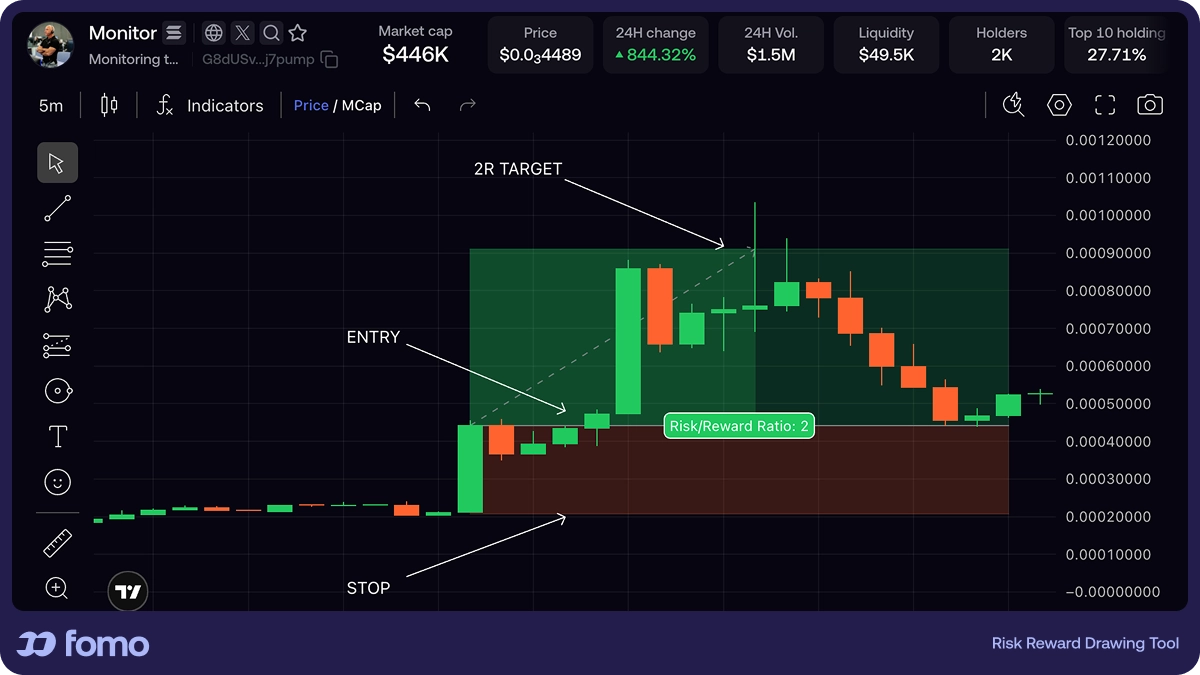
This guide breaks down exactly how to calculate the risk-reward ratio, size your positions, and apply the framework to real crypto trade setups—complete with a chart example you can reference immediately.
TL;DR
The risk-reward ratio compares how much you stand to lose versus how much you stand to gain on any trade. A 1:2 ratio means you risk $1 to potentially make $2. Combined with proper position sizing, it's the foundation of every sustainable crypto trading strategy. This guide is for beginner-to-intermediate traders who want a repeatable system for evaluating and sizing trades—not guesswork.
What Is the Risk-Reward Ratio?
The risk-reward ratio (often written as R/R or RRR) measures the potential downside of a trade against the potential upside. It answers one question: Is this trade worth taking?
Here's the core formula:
Risk-Reward Ratio = (Entry Price − Risk-Off Level) ÷ (Take-Profit Target − Entry Price)
If the result is less than 1, the potential reward exceeds the potential risk. If it's greater than 1, you're risking more than you stand to gain.
Most traders express the ratio in reverse as "1:X" for clarity. A trade where you risk $100 to potentially make $300 is a 1:3 risk-reward ratio—you stand to gain three dollars for every one dollar at risk.
Why It Matters in Crypto
Crypto markets are significantly more volatile than traditional equities. A token can move a great deal in a single day, which means poor risk management punishes you faster and harder. The risk-reward ratio provides a structured way to evaluate every trade before you enter it, regardless of whether you're trading Bitcoin or a freshly launched memecoin.
How to Calculate the Risk-Reward Ratio (Step by Step)
Step 1: Identify your entry price—the price at which you'll open the trade.
Step 2: Set your risk-off level—the price at which you'll exit if the trade moves against you. This should be based on a technical level (below support for longs, above resistance for shorts), not an arbitrary percentage.
Step 3: Set your take-profit target—the price at which you'll close the trade for a gain. This should also be based on a technical level, such as the next resistance zone or a measured move.
Step 4: Calculate.
Example (Long Trade):
- Entry: $2,000
- Risk-off level: $1,900 → Risk = $100
- Take-profit target: $2,300 → Reward = $300
- Risk-Reward Ratio: 1:3
For every dollar at risk, you stand to gain three.
Where to Find It in fomo
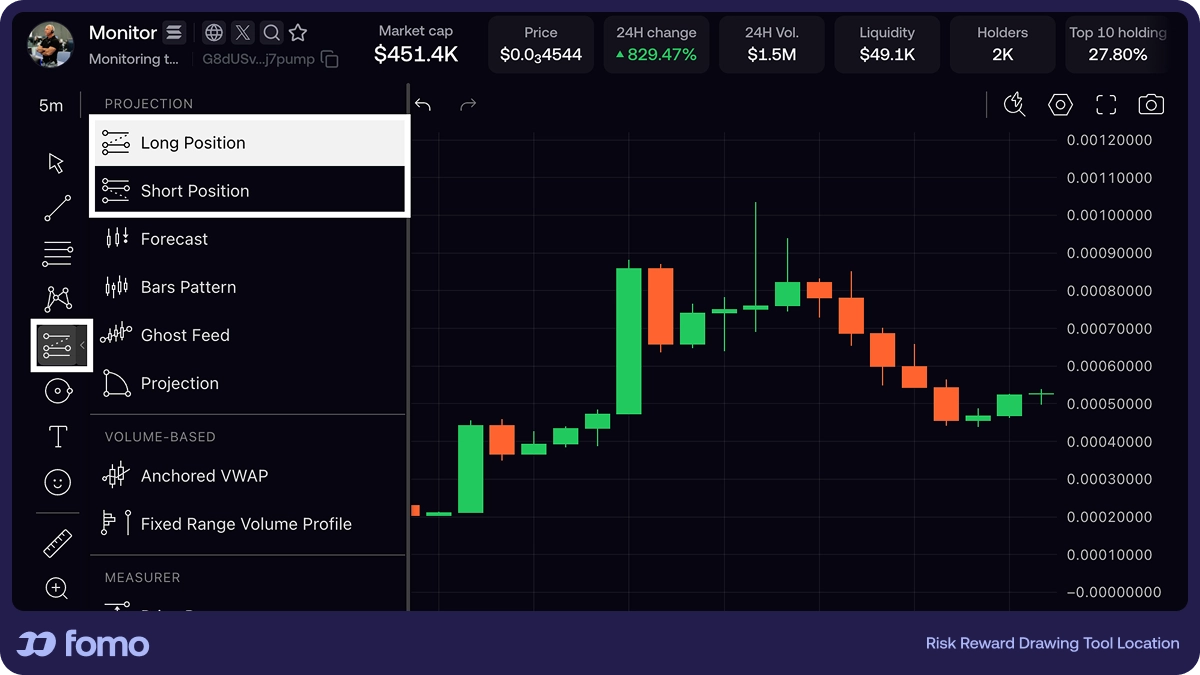
In fomo, the Long Position and Short Position drawing tools are located in the 5th icon down on the far-left panel of any token chart. Click the icon, select the tool you need, then drop it on the chart to set your entry, risk-off, and take-profit levels—fomo handles the ratio math for you.
What Counts as a "Good" Risk-Reward Ratio?
There's no universal answer, but most experienced crypto traders target a minimum of 1:2. Here's why: it changes the math on how often you need to be right.
Risk-Reward Ratio vs. Required Win Rate
| Risk-Reward Ratio | Win Rate Needed to Break Even | What It Means |
|---|---|---|
| 1:1 | 50% | Zero mathematical edge—you must win over half your trades just to tread water, and fees push you negative |
| 1:2 | 33% | You can lose 2 out of every 3 trades and still come out ahead |
| 1:3 | 25% | Only 1 winner in 4 trades keeps you profitable |
| 1:5 | 17% | Highly asymmetric—1 winner in 6 trades still nets a profit |
This is why 1:1 is not a real strategy
At 1:1, the ratio gives you nothing. Once you factor in trading fees, slippage, and the emotional cost of a coin flip, you're operating at a disadvantage. The whole point of improving your risk-reward ratio is to give yourself room to be wrong and still make money.
The key insight: a higher risk-reward ratio is more forgiving of losses. In a market as unpredictable as crypto, that forgiveness is valuable. You don't need to be right most of the time—you need your winners to significantly outweigh your losers.
Position Sizing: Where Risk-Reward Meets Your Real Money
Knowing your risk-reward ratio is only half the equation. The other half is position sizing—determining how many dollars (or tokens) to commit to a trade based on the risk you're willing to take.
The Formula
Position Size = (Account Balance × Risk %) ÷ (Entry Price − Risk-Off Level)
The most common rule of thumb is the 1–2% rule: never risk more than 1–2% of your total trading account on a single trade.
Example
- Account balance: $10,000
- Risk per trade: 2% → $200
- Entry price: $100
- Risk-off level: $95 → Risk per unit = $5
- Position size: $200 ÷ $5 = 40 units
You'd buy 40 units. If the trade hits your risk-off level, you lose exactly $200—2% of your account. No more.
Why Position Sizing Matters More Than You Think
Without position sizing, risk-reward ratios are theoretical. You could have a perfect 1:3 setup, but if you put 50% of your portfolio into it and get stopped out, you've just lost half your trading capital. Position sizing is what converts a good ratio into a survivable strategy.
Pro tip: Tighter risk-off levels let you take larger position sizes while risking the same dollar amount. But tighter levels also mean you're more likely to get stopped out by normal price noise. There's always a trade-off between position size and breathing room.
Applying Risk-Reward to Crypto Trade Setups
Setup 1: Buying a Pullback to Support (Long)
This is the most common high-R/R setup. A token is in an uptrend, pulls back to a known support level, and you enter expecting a bounce.
- Entry: At or near the support level
- Risk-off level: Just below support (if support breaks, your thesis is invalidated)
- Take-profit: The previous high, or the next resistance zone
The risk-off level is tight because support is nearby, and the potential reward stretches to the next major level above. (See the chart above for a visual example of this setup.)
Setup 2: Shorting a Rejection at Resistance (Short)
A token rallies into a resistance level and shows signs of rejection (long upper wicks, declining volume).
- Entry: At or near the resistance rejection
- Risk-off level: Just above the resistance level
- Take-profit: The next support zone below
The logic mirrors the long setup, just inverted. You're risking a small move against the resistance level to capture a larger move down to the next support zone—ideally yielding a 1:3 ratio or better.
A Note on Memecoins and High-Volatility Tokens
Memecoins and newly launched tokens move faster and more unpredictably than blue-chip crypto. The risk-reward framework still applies, but with some adjustments:
- Widen your risk-off levels slightly to account for higher volatility and thinner liquidity.
- Reduce your position size. If the asset is 3× more volatile than Bitcoin, consider risking 0.5% of your account instead of 2%.
- Look for asymmetric setups. Because memecoins can run 5–10× or more, a well-placed entry with a tight technical risk-off level can yield 1:5 or 1:10 ratios.
The key is that higher volatility demands smaller position sizes—not bigger ones.
Common Mistakes Traders Make with Risk-Reward
1. Setting targets that are unrealistic
A 1:10 ratio sounds great, but if your take-profit target has no technical basis, price is unlikely to reach it. Always anchor targets to real levels on the chart.
2. Moving the risk-off level
The moment you move your risk-off level further away mid-trade to "give it more room," you've changed your ratio and your position sizing math. If the original level is invalidated, exit.
3. Ignoring the ratio entirely
Many traders enter positions based on gut feeling or social media hype without ever calculating what they're risking versus what they stand to gain.
4. Confusing risk-reward with certainty
A 1:3 ratio doesn't mean the trade will work. It means that if you apply this framework consistently, your winners should outpace your losers over a large sample of trades.
5. Oversizing on "high conviction" trades
Even your best ideas can fail. The 1–2% rule exists to keep any single trade from damaging your account beyond recovery.
Quick Checklist: Before Every Crypto Trade
Use this checklist before opening any position:
- ✅ Have I identified a specific entry price?
- ✅ Is my risk-off level based on a real technical level (not arbitrary)?
- ✅ Is my take-profit target based on a real technical level?
- ✅ Is the resulting risk-reward ratio at least 1:2?
- ✅ Have I calculated my position size using the 1–2% rule?
- ✅ Am I comfortable losing this exact dollar amount if the trade fails?
If the answer to any of these is "no," reconsider the trade or adjust your parameters.
How Social Signals Can Improve Your Risk-Reward Decisions
One emerging edge in crypto trading is using real-time social data to validate (or invalidate) a setup before you enter.
For example, seeing that top-performing traders are accumulating a token near a support level adds conviction to a long setup. Conversely, noticing that profitable traders are exiting a position can serve as a warning sign before you commit capital.
Platforms like fomo integrate this kind of social intelligence directly into the trading experience. On fomo, you can easily track other traders' buys and sells, view how profitable traders are on a given token, and follow top traders with real-time notifications when they enter or exit positions. Leaderboards showing the most profitable traders across 24-hour, 7-day, and 30-day windows give you additional context when evaluating whether a setup has real conviction behind it—or if you're trading alone.
This doesn't replace your risk-reward analysis. But it adds a layer of confirmation that most standalone charting tools can't provide.
Why fomo Makes Risk-Aware Trading Easier
fomo is a social crypto trading app that simplifies the mechanics of execution so you can focus on strategy. You can sign up in under 30 seconds, fund your account instantly with Apple Pay or a debit card, and trade across Solana, Base, BNB Chain, Ethereum (ETH), and Monad from a single unified USD balance—no manual bridging required.
For traders applying risk-reward frameworks, fomo's real-time P&L tracking, historical equity curves, and per-trade profit analysis make it easy to review whether your ratios are holding up over time. You're not flying blind.
FAQ
What is the risk-reward ratio in crypto?
It's a metric that compares how much you could lose on a trade to how much you could gain. A 1:2 ratio means you risk one dollar to potentially earn two. It helps crypto traders evaluate whether a trade is worth entering.
How do you calculate the risk-reward ratio?
Subtract your risk-off level from your entry price to find the risk. Subtract your entry price from your take-profit target to find the reward. Divide the risk by the reward. A result below 1 means the reward exceeds the risk.
What is a good risk-reward ratio for crypto?
Most traders aim for at least 1:2. This means you can be wrong on more than half your trades and still be profitable. For highly volatile tokens, some traders target 1:3 or higher.
What is the 1% rule in trading?
The 1% rule means never risking more than 1% of your total account balance on a single trade. On a $10,000 account, you'd risk no more than $100 per trade.
What win rate do I need for a 1:2 risk-reward ratio?
Approximately 33%. You only need to win about one out of every three trades to break even. Anything above that is profit.
Can the risk-reward ratio work for memecoins?
Yes, but you should adjust for higher volatility by using wider risk-off levels and smaller position sizes. Memecoins can offer extremely asymmetric ratios (1:5 or more) when the setup is right.
How does position sizing relate to risk-reward?
Position sizing determines how much capital you allocate to a trade based on your risk-off distance and the percentage of your account you're willing to lose. It converts your risk-reward ratio from a theoretical number into a concrete dollar amount.
Should I always use the same risk-reward ratio?
Not necessarily. Market conditions matter. In trending markets, you may target wider ratios like 1:3 or 1:4. In choppy, range-bound markets, a 1:1.5 or 1:2 ratio may be more realistic.
Key Takeaways
- The risk-reward ratio is (Entry − Risk-Off Level) ÷ (Take-Profit − Entry). Target at least 1:2.
- A higher ratio means you need to win fewer trades to be profitable.
- Position sizing converts your ratio into actual dollars at risk. Use the 1–2% rule.
- Risk-off levels and take-profit targets should be based on real technical levels—not emotions.
- Memecoins and volatile tokens demand smaller positions, not bigger ones.
- Social signals from platforms like fomo can add conviction to your setups.
- Consistency beats conviction. Apply the framework to every trade, not just the ones you feel strongly about.
Disclaimer: This article is for educational purposes only and does not constitute financial advice. Crypto trading involves significant risk, including the potential loss of your entire investment. Always do your own research and consider consulting a financial professional before making trading decisions.