Managing Your Risk and Portfolio: How To Win Over Time
fomoDecember 25, 2025

The world of crypto is conflicting. Yes, it gives you the opportunity to make a whole lot of money very quickly, but it's also a place where you can lose a lot of money just as fast.
So, how does one keep their portfolio intact? How does one navigate through all the landmines to come out unscathed and profitable at the end?
Well, there is no definitive answer. However, there are practices you can put in place to give you the best chance of winning.
The get-rich-quick trading might sound exciting at first because you also want to hit the moonshot like all the other people you read about, but just know that for one success story, there are thousands of people who got burned.
Boring trading is often profitable trading. At the end of the day, crypto is a marathon, not a sprint. One must bide their time, be patient, survive, and strike when the iron is hot.
So today, we are going to show you how to do just that by practicing risk management.
Risk vs Reward
Before doing anything else, it is essential to grasp the concept of risk versus reward.
The idea is to ask the question, "How much am I willing to lose (risk) and how much am I expecting to gain (reward) on a given trade?"
This is defined by the risk-to-reward ratio (R:R).
- For every $1 at risk, I expect to gain $2 - 1:2 RR (this is good)
- For every $1 at risk, I expect to gain $3 - 1:3 RR (this is excellent)
Let's look at a scenario to further simplify this. Let's say you're looking to buy DOGE. You have two ways to set up the trade.
- Option 1 - You buy $50 worth and set a stop-loss at $45, aiming to take profit at $60. You are risking $5 in order to make $10. That's a 1:2 RR.
- Option 2 - You put $100 worth in the coin, being okay with losing it all, but based on your analysis, you expect the coin to pump and take a profit when you reach a total position of $400. You're risking $100 to make $300. That's an R:R of 1:3.
Note that DOGE is just an example here; with mememcoins, things tend to be a lot more fluid, especially in the early stages, with most traders not using hard stop losses/take profits.
But nonetheless, in general, when looking to set up a trade, you should look for trades that have an R:R of 1:3 or more. With a 1:3 R:R, you only need to be right more than 25% of the time to be profitable. So if 26 out of every 100 trades are correct, you will be profitable.
You are not required to be a genius, just consistently take good bets.
But of course, there is no golden ratio here. It varies based on a trader's preference and skill set. Understanding R:R is simply a great way to manage your risk and stack consistent wins.
Position sizing
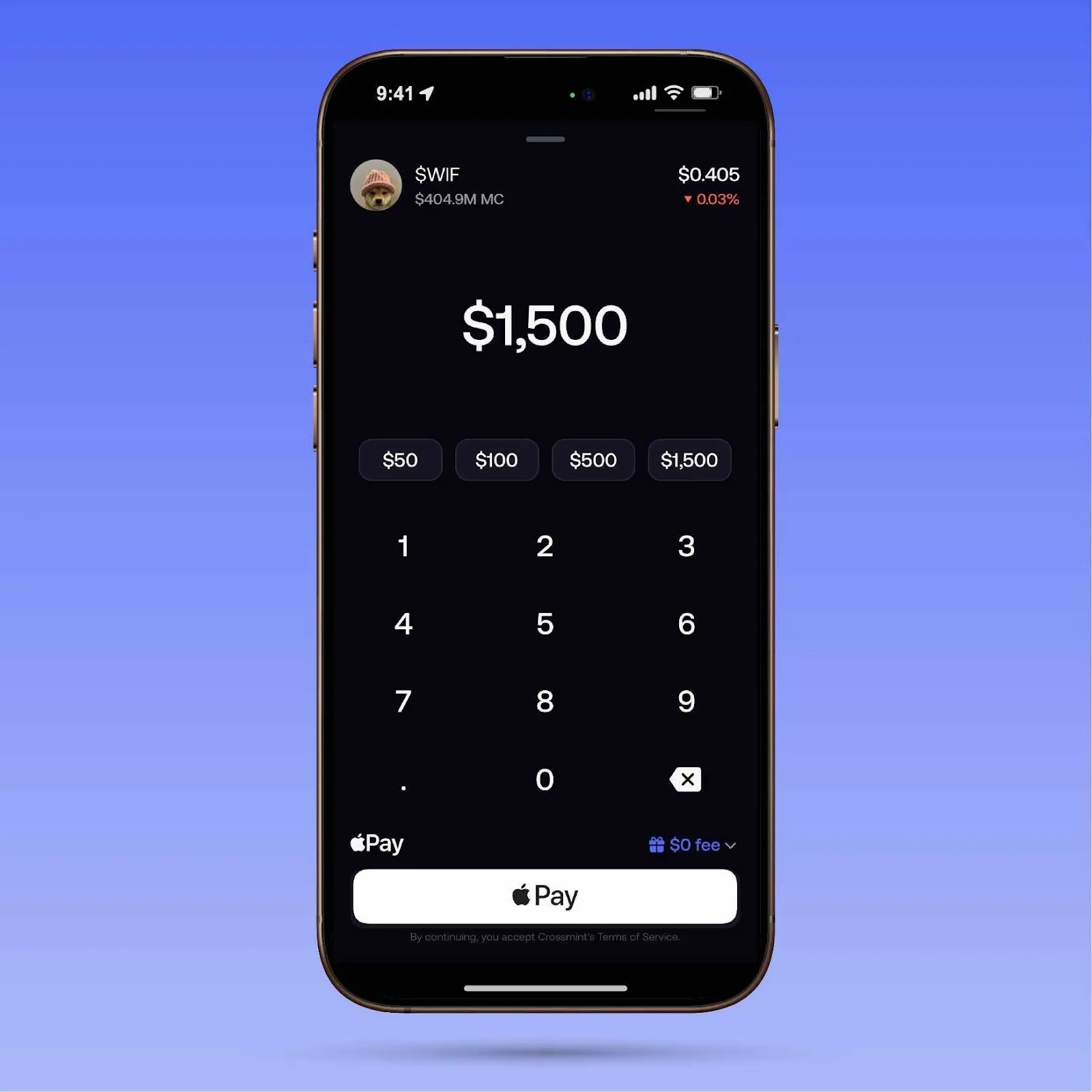
Sizing refers to the amount you allocate to a specific position in your portfolio. Sizing your positions correctly is essential for managing the risk in your portfolio and ensuring that you can enter/exit trades smoothly based on liquidity.
When you're dabbling in more volatile/risky assets like memecoins, for example, a good rule of thumb is to not risk more than 1%-2% of your portfolio on a particular position.
Picture this: animal memecoins are making a comeback, and your friend believes this new coin called FROGGY is going to be the next big thing. Yes, it is tempting to go all-in, but take a breath and think first.
Say your total portfolio is $10K. Rather than allocating $2K-$3K hoping to hit a homerun, instead go for $100-$200. If it pumps hard, you will still make a decent amount of money relative to your portfolio. You can take that profit and churn it into another memecoin.
However, if it turns out NOT to be the next big thing, as these things often play out, instead of losing 20%-30% of your portfolio on one trade, you'll only be losing 1%-2%.
Since you sized smartly, you'll come out of it unscathed, but those who went all-in and didn't manage risk with sizing would be down really bad.
A good way to think about it is if you draw down 50% on your portfolio, you'll need to make 100% just to get back to breakeven. So you need to be smart about the way you allocate.
If you size small amounts of your portfolio on degen/volatile assets, it gives you room to allocate more to major assets like ETH/SOL/BTC.
You can be more comfortable allocating 50%-70% of your portfolio in major assets to make steady returns while you keep churning more volatile wins using only a small amount of your portfolio.
This is how you size your trades if you're looking to manage your risk and be here for the long run. Remember, marathon not a sprint.
Managing positions
Once you have opened your positions, you must exercise some of these basic strategies to manage your positions.
The first is to have mental levels in place where your trade is either invalidated or you take profit. Basically, make a plan and stick to it.
Suppose you buy a coin at $1M Mcap. You should have levels to cut your losses or take your profits. So if the coin goes to $800K Mcap, you cut your losses. Conversely, if you have a target of $10M, take some profit at that level and maybe hold a little left over in case the coin continues to pump.
This way, you're protected on the downside and when the coin pumps, you secure your initial investment plus some profit.
The other strategy to keep in mind is dollar-cost averaging (DCA).
Suppose you find an asset that you believe in long-term, timing the market is incredibly tough. It may take time for your thesis to play out.
With a DCA, you basically buy the asset in increments. For example, you might buy $500 worth of the coin every week until you've invested a total amount that you're comfortable with.
This way, you invest at multiple price points, bringing your average investment price if the coin keeps going down. Eventually, once your thesis starts playing out, you will make a healthy profit on your total DCA in a relatively stress-free manner.
No need to time the market if you spend more time in the market.
Portfolio management
Position management is one thing, but we also need to take a step back and look at the portfolio as a whole.
People employ multiple strategies in constructing a trading portfolio, but here are the basic strategies for consistently generating returns while staying relatively safe from the extreme volatility of the crypto market.
Diversification is important. In an asset class like crypto, it is very risky to have all your eggs in one basket because there is always a chance that something can go wrong. Whether it's a hack, exploit, insider scam, rugpull, or a black swan event, the possibilities are endless.
It's good to be diversified across major assets (BTC, ETH, SOL) as well as smaller assets (popular narrative of the moment in the altcoin market).
Ideally, your portfolio should be more heavily weighted towards the majors that steadily chug along. Meanwhile, you can have a smaller allocation for volatile assets that could generate outsized returns. This will help you minimize your risk.
If you do generate outsized returns on your altcoins, you can churn them back into your majors and grow your portfolio continually.
On the other hand, there is a compelling argument for concentration. That involves spending a lot of time conducting thorough research and selecting only a few assets, typically 2-3 in total, and allocating your entire portfolio to those assets.
This strategy can be highly successful and generate higher returns than diversification if executed correctly, but it requires extensive research and skill.
If you're new to crypto and trading, the diversification approach is a safer and more controlled option.
Another key aspect of portfolio management to consider is rebalancing.
When building out a portfolio, it's good to have target ratios for how you want your allocations to look. For example:
- 50% BTC
- 30% ETH & SOL
- 10% Stablecoins
- 8% Small caps and mid caps
- 2% Degen trading
Now imagine you put some money into a memecoin, which would come under the "degen trading" side of your portfolio. As it turns out, you hit the jackpot, and this coin actually runs +10,000%.
Now, all of a sudden, instead of 2% the memecoin might become 10%-15% of your portfolio. In this scenario, you start rebalancing. Begin selling a portion of your position and redistribute across the other assets in your portfolio.
Now your portfolio is rebalanced and bigger, but at the same time, you have managed your risk because you do not have a significant portion of your networth in a highly risky memecoin.
Fortunately, the fomo app makes all of this trivially easy for you.
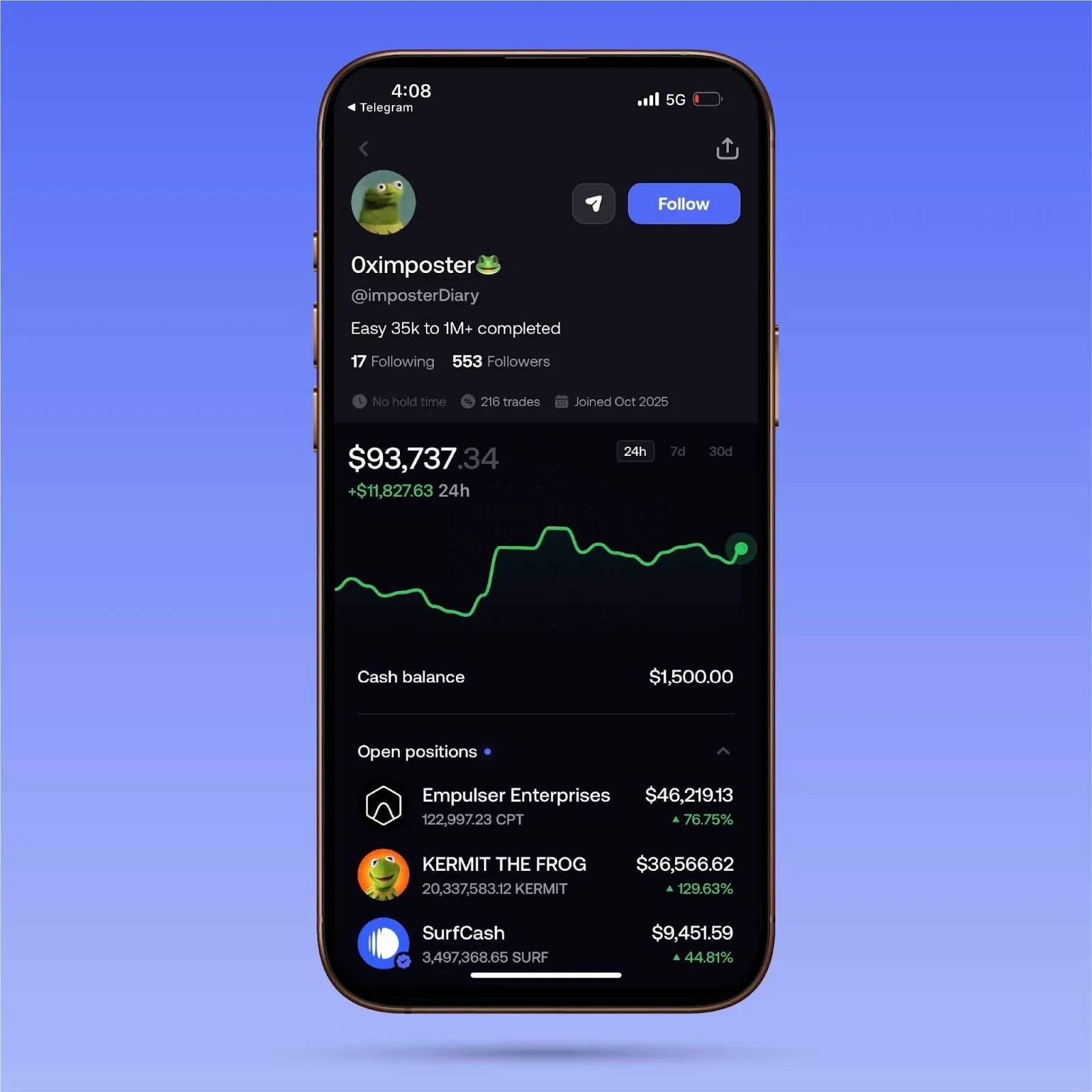
On your profile page, you will get a detailed breakdown of all the assets in your portfolio and the distribution. This should make it easier for you to rebalance when needed.
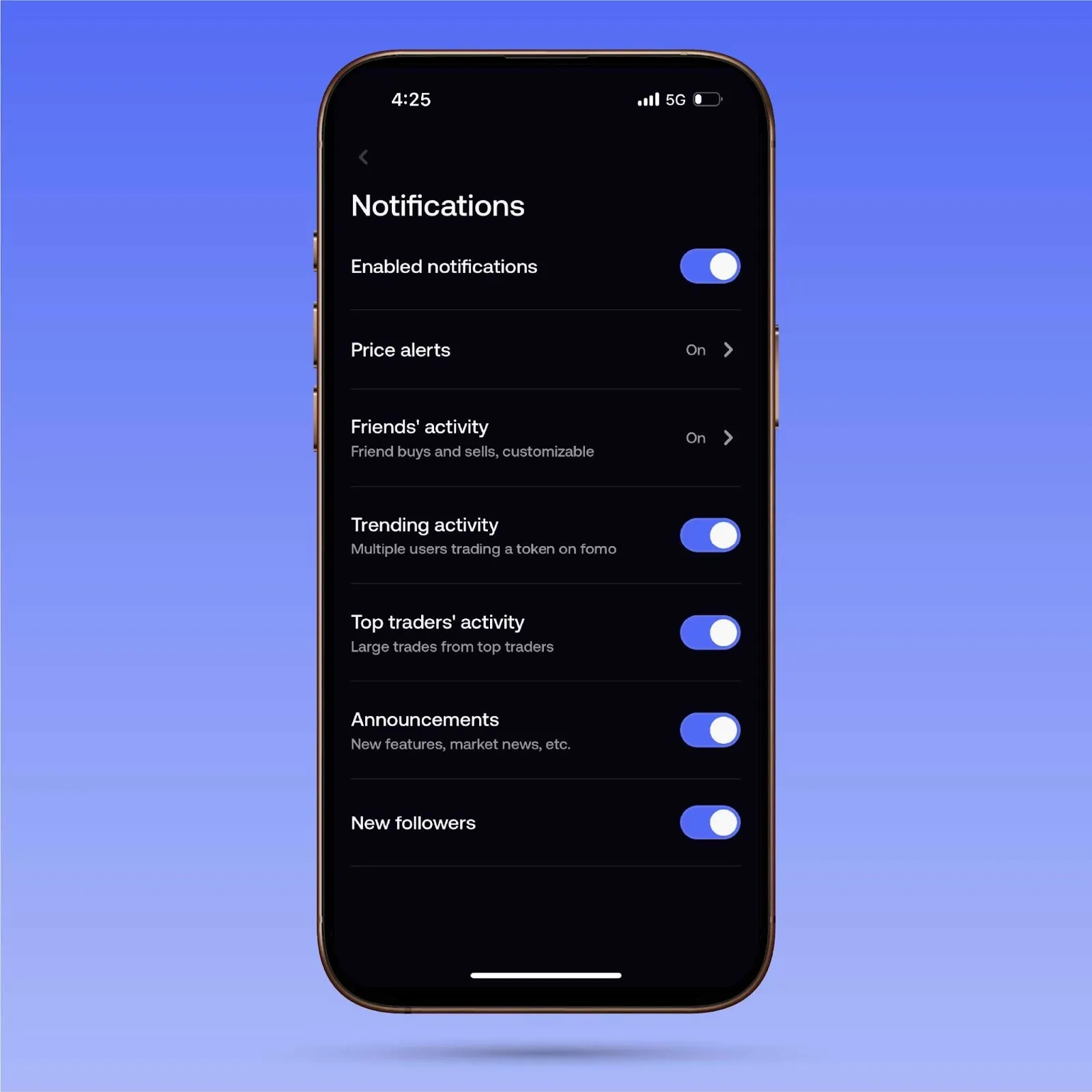
If you want to know when to enter/exit a trade or if you're doing a DCA, you can leverage fomo's customizable notifications to instantly stay up to date with all the movements in the market.
fomo also has a very rigorous verification process. So if you want to be extra safe, you can also only interact with verified assets.
Whether you're buying, selling, tracking, discovering, or rebalancing, fomo is the only app you will need for your crypto trading journey.
To stay up to date with all the latest updates from fomo, be sure to follow us on X and join the Discord. To learn more about fomo, be sure to check out the website.