Decoding Token Stats: What is Market Cap, Liquidity, and Volume
fomoDecember 25, 2025


Let’s say you’ve used fomo’s social feed to find the token that you think will be the next 100x.
While most degens would opt for the “Ape first, research later” approach, it’s still essential to be informed about the basic statistics of the token you’re considering.
So let's decode the basics of token stats.
In this article, we'll be taking a look at:
- Market Capitalization
- Liquidity
- Volume
What is Market Capitalization (market cap)?
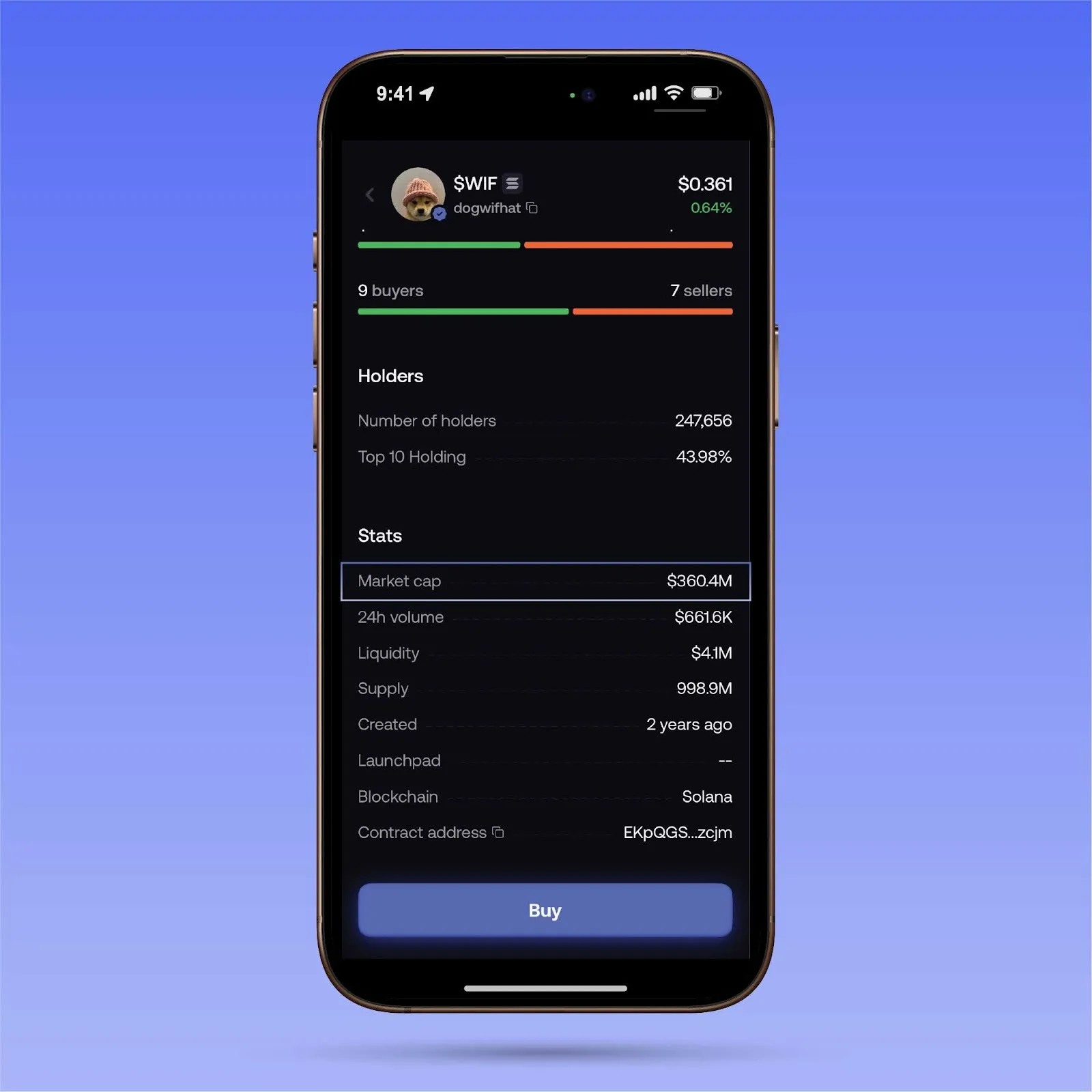
The market cap of a token is the price of the token multiplied by its supply. Based on market cap, tokens can be divided into the following categories:
- Under $1M - Shitcoin
- $1M - $100M - Micro-cap
- $100M - $1B - Small-cap
- $1B - $10B - Mid-cap
- $10B+ - Large-cap
However, within the crypto world, you will often see two distinct groups. Market cap and fully diluted valuation (FDV).
- Market cap - the market cap typically refers to the circulating market cap. That is, the price of the token multiplied by the current circulating supply of the token.
- Fully diluted valuation (FDV) - FDV refers to the current price multiplied by the total supply of the token. This includes all the tokens that aren't currently in circulation but will be in circulation in the future.
It's important to be wary of the distinction and know whether you're valuing a token based on the circulating market cap or the FDV.
With that being said, why does market cap even matter? I can just look at the price of a token, and if it's low, it might be worth buying, right? Well, you'd unfortunately be wrong.
Let's take a look at a hypothetical example.
Imagine there are two memecoins. Coin A and Coin B.
The price of Coin A is $1, and the price of Coin B is $5. Naturally, Coin B appears to be more expensive, so it makes more sense to buy the cheaper one for more gains, right? This is where market cap comes in.
The supply of Coin A is 1,000,000, and the supply of Coin B is 100,000. So let's run the math.
- Market Cap of Coin A - $1 x 1,000,000 = $1M Market Cap
- Market Cap of Coin B - $5 x 100,000 = $500K Market Cap
So, although the price of Coin A might be lower in dollar terms, in terms of actual valuation, Coin B is the cheaper asset.
On the fomo app, when you click on the token you are about to buy, make sure to first click on "about" and scroll down. You will see all the information about the Market Cap and supply of the token to make an informed decision.
What is Liquidity?
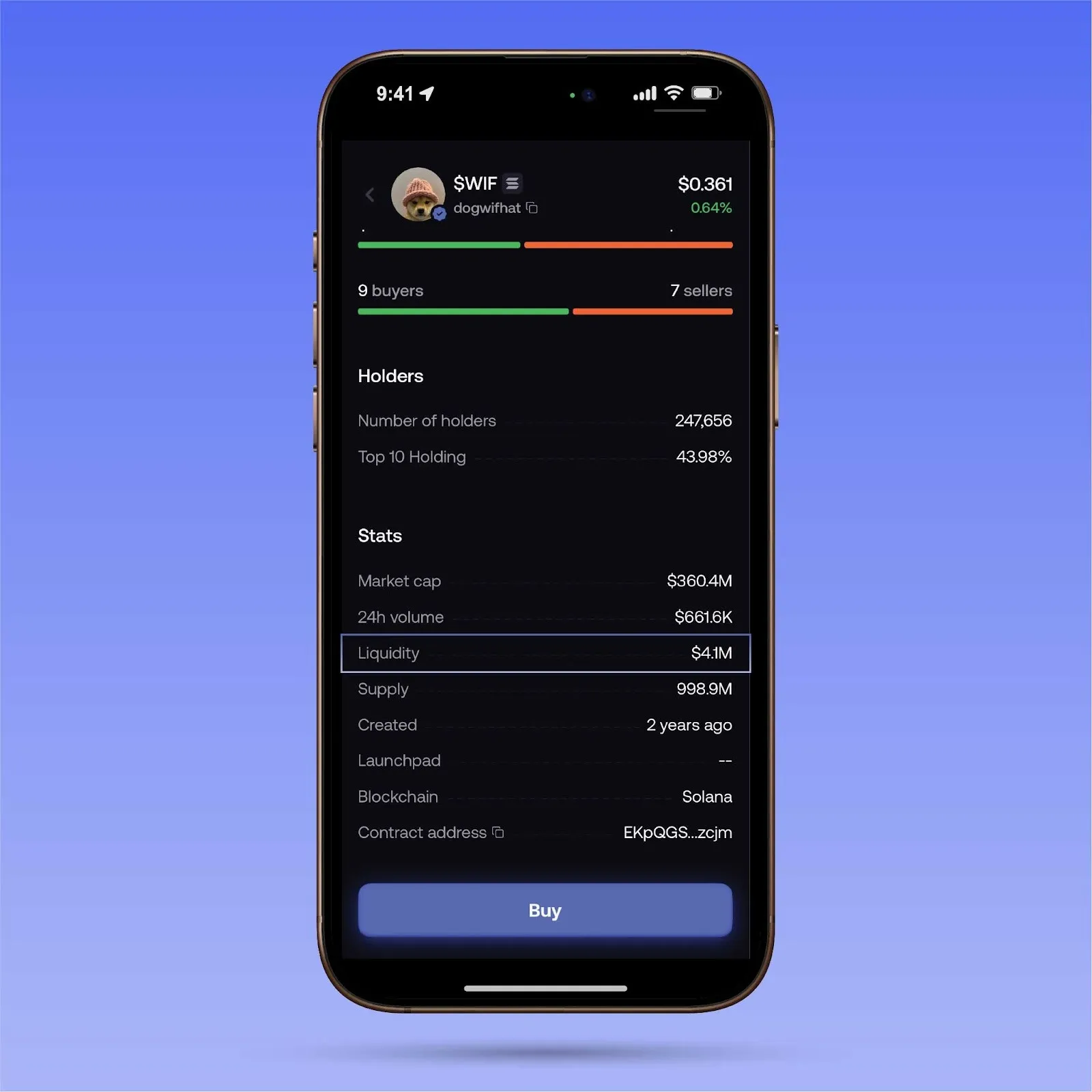
Liquidity is a measure of how easily assets can be bought or sold in dollar terms. An asset with higher liquidity will be easier to trade, while an asset with low liquidity will be more difficult to trade.
In the world of onchain trading, liquidity is crowdsourced. Any user from anywhere in the world can put their money into this shared liquidity pool.
Whenever a trader buys or sells an asset, they do so from the liquidity available in this shared pool of assets.
The reason this shared pool works is because those depositing into these pools get rewards in the form of yield, generated from trading fees.
Before purchasing an asset, it's essential to know its liquidity. Let's understand why.
The liquidity will determine your sizing on the trade, i.e., how much money it makes sense to put into the coin.
Typically, lower market cap coins have lower liquidity (making them harder to trade), while higher market cap coins have higher liquidity (making them easier to trade).
Let's say you're looking to put $5K into one coin as an all-or-nothing trade. You have a choice between Coin A and Coin B.
Coin A has $100,000 in liquidity, while Coin B has $1,000,000 in liquidity.
If you put the $5K into Coin A, you are very likely to experience something called slippage.
Slippage refers to the difference between the expected price of a trade execution and the actual price.
Suppose you wanted to buy a token at $1, but because the liquidity is low, you actually ended up buying it at $1.20 and got 20% less than what you expected.
In this case, since your trade is 5% of the total liquidity available, it will cause a spike, making your price execution worse. On low liquidity coins, slippage can give you -20% to -50% hits if you're not careful.
From the outset, your $5,000 will now become $4,000 (or lower). You're already on the back foot.
In this case, it makes sense to size down, rather than eat the slippage and save some money.
Conversely, if you buy $5,000 worth of Coin B, your experience will be significantly easier.
With $1M in liquidity, your $5,000 investment will not have a significant price impact. Even if you make a substantial profit and want to sell later on, you should be able to do so smoothly with minimal slippage.
So if you're trading low market cap coins, 99.9% of the time you will be dealing with low liquidity. This will not only give you slippage issues, but if you're up a lot, it will also impact how much profit you're actually able to realize.
You may think that you're up 10,000% on a coin, but because the liquidity is so low, you won't be able to realize all of it. In reality, when you sell, you will only be getting a fraction of that.
On the fomo app, in the same "about" section, scroll to the bottom and always check the total liquidity of the coin you are purchasing. Be cautious of low-liquidity coins, as they can impact your trades, both in buying and selling.
What is Volume?
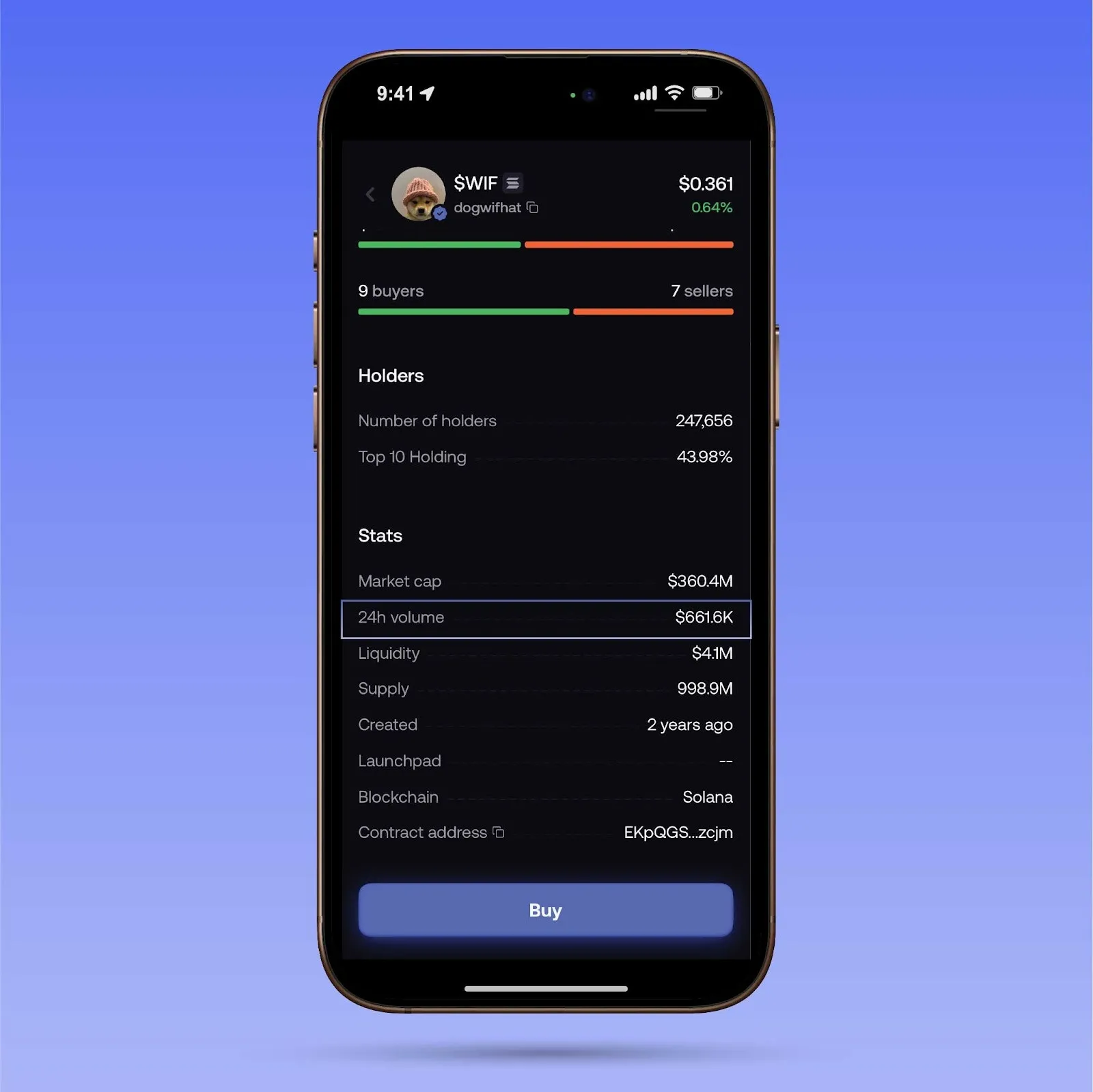
Volume is the total amount of a cryptocurrency that has been traded over a specific period of time. Although it's typically shown over a 24-hour period, volume can be filtered for a 7-day, 1-month, 1-year, or all-time period.
The volume is the total number of units that have been bought and sold over the period you have filtered for. This is usually denoted in USD terms, but depending on the denominator asset, it can also be shown in BTC, ETH, or SOL terms.
So why is volume important?
- Market sentiment - A coin that has high volume could be a signal of strong interest from other traders/investors. High volume signals high activity, which traders can use as a sign that the market sentiment around this coin is positive. If volume is low, it's likely due to low interest, which would indicate poor market sentiment for the coin in question.
- Trend confirmation - If a specific sector or coin is gaining traction with a price increase, analyzing the volume can be a good indicator of whether the trend is sustainable or not. A rising price supported by high volumes is a good indicator that the trend for the coin is real and could see continuation; however, a rising price on low volumes could indicate that it's merely a short-term run with no sustainability.
- Breakout confirmation - If you're looking at a coin that's just about to break out of a trend or break new all-time highs, make sure to keep an eye on the coin's volume. A breakout on high volume could be confirmation that the move is strong, and price discovery can be expected. However, if it's on low volume, the breakout has a high chance of getting rejected/reversing.
- Liquidity - Volume also relates to liquidity. If you see consistently high volume on a coin, it means that it has good liquidity because all traders/investors are able to buy/sell the asset with ease. You can be assured that when you invest, you shouldn't encounter any of the issues with poor liquidity.
While all of this is mostly true, it's important to keep note of something called spoofing.
Malicious actors use multiple wallets to create an illusion of activity to make people think that there is activity in the coin, but in reality, it's all been spoofed.
Wallet A will buy a coin and then immediately send it to Wallet B. Wallet B will then immediately sell the coin. There's no real net difference for the malicious actor, but the activity between these wallets has generated fake volume.
So this is something to be wary of.
On the fomo app, if you go to the same "about" section of the coin and scroll down, you will be able to see the 24H volume of the coin.
A more informative section is the "transactions" section.
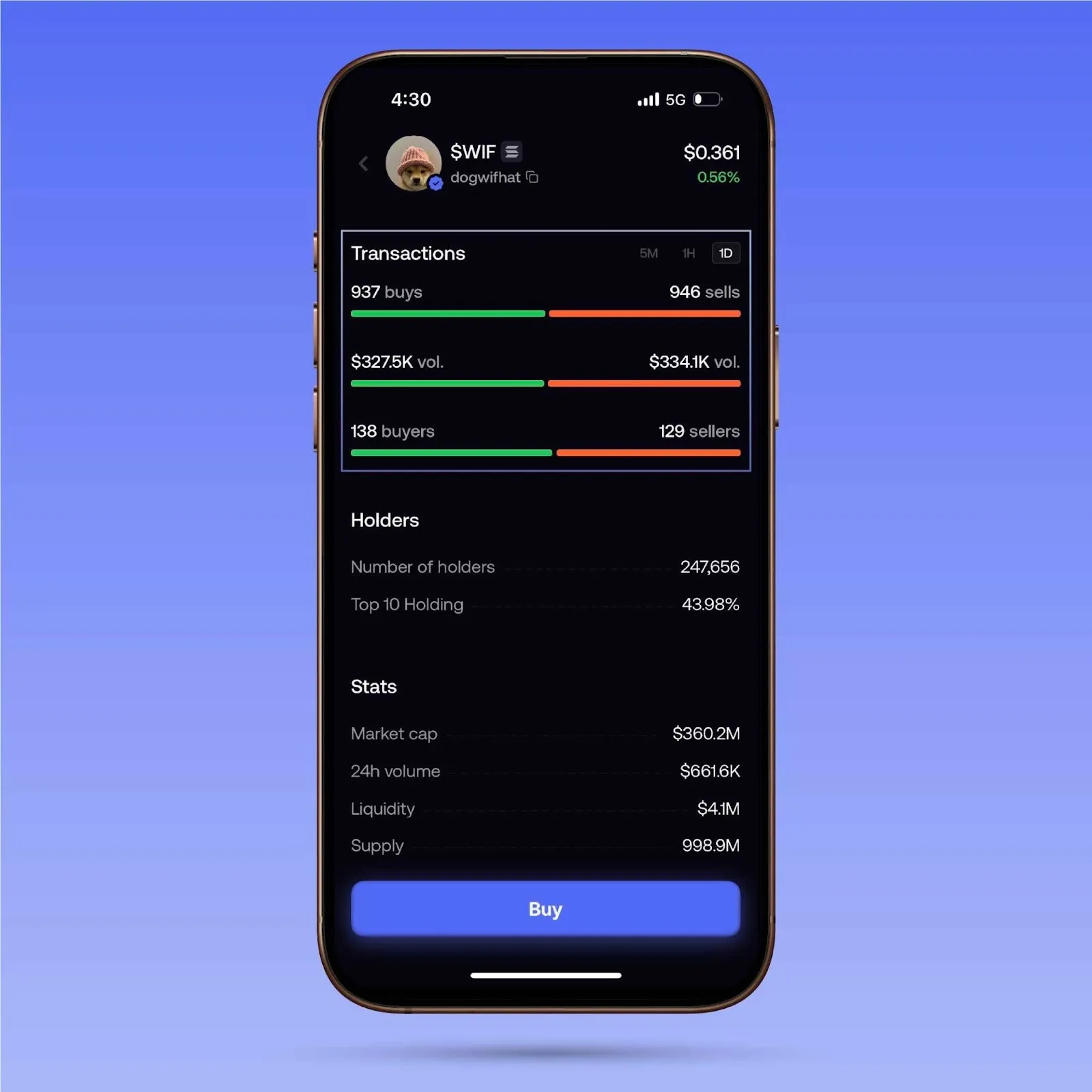
This breaks down volume and divides it by buy volume and sell volume. You can also filter it for 5 minutes, 1 hour, or 1 day, depending on what you're looking for.
You will be able to see how much of the volume is from buys and how much is from sales. Based on that, you can decide if the coin is worth buying or not.
Now, you should be familiar with all the basics of token stats. No matter how tempting it is to ignore everything and just immediately throw your money into a coin, make sure to take the time to at least go over these basics, because it may end up saving you a lot of money.
Happy trading!
To stay up to date with all the latest updates from fomo, be sure to follow us on X and join the Discord. To learn more about fomo, be sure to check out the website.