4pfCoyote Lost $250K and Rebuilt: Lessons on Tilt, Ego, and Reading the Solana Chain
fomoJanuary 22, 2026

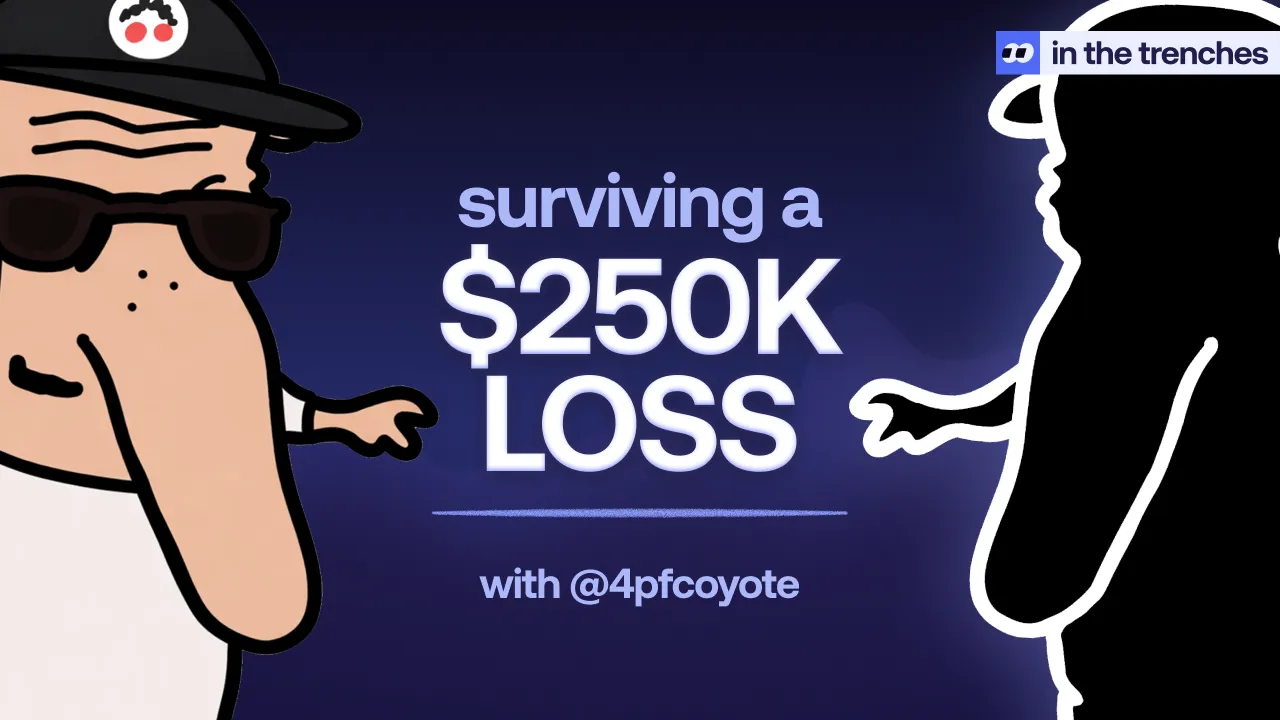
In crypto trading, the stories worth hearing are often about losses, not wins. Coyote, a trader with a traditional finance background who became one of Solana's early onchain participants, learned his most valuable lessons through a quarter-million-dollar drawdown. His experience reveals how psychological weaknesses compound during losing streaks and how the skills that create edge can be undermined by poor adaptation to new tools.
From Traditional Finance to Perpetual Futures
Coyote's path to crypto began unconventionally. Working in finance, he started like many do, as what he calls a "superfish options trader" playing with $500 on Robinhood at his day job.
A friend introduced him to perpetual futures, which led him to search for where these instruments traded. That search brought him to a Discord community run by someone named RB, who ultimately turned out to be fraudulent. But that failed community connected Coyote to someone named Hopium, who would change his trajectory.
"This guy Hopium was begging me to buy Pepe at 8 mil," Coyote recalls. "And I essentially laughed at him thinking like, I don't know what this is. Like, what do you mean? There's no centralized exchange to trade these. This sounds like a scam."
That dismissal of early Pepe became what he calls a "super super big fumble" and pushed him to take onchain trading seriously.
The Solana Edge
After arriving on Ethereum's memecoin scene as a break-even or losing trader, Coyote made a bet that transformed his career: committing entirely to Solana before almost anyone else.
"I was on Solana probably before pretty much everybody, when there was actually like hundreds of thousands of volume per day," he explains. The experience simply felt better than trading on Ethereum.
More importantly, he developed a skill that others avoided: reading Solscan.
"There was a ton of complaints about Solscan being difficult to read compared to Etherscan and I actually felt the exact opposite," he says. "To this day I still cannot read Etherscan, but I was very proficient with Solscan."
This proficiency became his first real edge. In Solana's early days, supply control schemes and wash trading were less sophisticated. Someone who could read the chain could spot these patterns and avoid getting trapped, or position ahead of legitimate accumulation.
Building GC Capital
Coyote's approach to building edge went beyond individual skill development. He founded a group called GC Capital by identifying traders who "actually did this for real" versus casual participants.
His filtering criteria for finding quality traders:
Unbiased Market Approach: People who could shift their thinking without attachment to previous positions
Time Commitment: Dedicated traders in an era before "the great lock in" became crypto culture
Continuous Improvement: Traders focused on getting better rather than defending their current abilities
Curiosity and Innovation: People thinking about markets in unconventional ways
He explicitly avoided using win rate as a filter, considering it a poor measure of trading ability.
The $250K fomo Loss
Coyote's most instructive experience came from losing a quarter million dollars on the fomo trading app. Importantly, this was not a single catastrophic trade but "death by a thousand cuts" - repeatedly depositing 30-50K and losing it.
Several factors combined to create this drawdown:
Ignoring Red Light Markets: He traded aggressively during periods that warranted stepping back.
USD Denomination Shift: Having always thought in terms of SOL equals SOL or ETH equals ETH, seeing trades denominated in dollars created different psychological pressures. He made poor decisions based on being up or down in USD rather than whether his thesis was valid.
Following Too Many Traders: The app's social features led him to chase notifications. "When I would get that notification of like 19 people that you follow bought $62,947 of X coin, I did a lot of top blasting when I shouldn't have."
Trading Unfamiliar Chains: UniBalance made it easy to trade on EVM and BSC chains where he had no edge. His two biggest losses, Hyperstition and Haven, were both EVM trades where he "had no business trading."
Improper Position Sizing: He knew how to size positions in SOL but not in USD. "I really should have been looking like okay what my normal size would have translated in US dollars. But instead I was just firing."
The Wallet Tracking Problem
Counterintuitively, Coyote considers wallet tracking, a strategy many traders obsess over, to be overrated and potentially harmful.
"I don't really track wallets," he states. "Probably a good portion of the reason why I've lost a quarter million dollars on fomo is because the wallet tracking is a lot more in your face."
His reasoning:
- Wallet tracking shakes him out of good positions
- It prevents him from buying things he should
- It creates analysis paralysis
- The sophistication of fresh wallets and vanish tools has eliminated most insider signal
- It promotes a too-granular view when a thousand-foot perspective is needed
He acknowledges wallet tracking can measure trade crowdedness, which has value, but disputes its utility as a primary strategy.
Understanding Tilt
Coyote distinguishes between two forms of trading tilt:
Notional Tilt: Discomfort with the absolute dollar amount lost
Ego Tilt: Frustration with being wrong, treating trading like a video game scoreboard
He experiences primarily ego tilt: "I get frustrated that I'm losing not so much about the money but more so about the fact that my ego is too big to accept that I made poor decisions."
His management approach involves sizing down dramatically while continuing to trade. "I think oftentimes for people dealing with like that kind of tilt, it's better to continue playing but just like with a fraction of what you were playing with before."
This allows continued market exposure for skill development without the risk of catastrophic loss during compromised psychological states.
Red and Green Flags
Coyote's framework for market participation:
Green Flags:
- High volume with lots of coins reaching moderate market caps (not just a few going very high)
- Novelty - new concepts that are difficult to value
- Things that allow people to dream about possibilities
Red Flags:
- Large extraction events (not just rug pulls, but PvP bloodbaths like Nero)
- Poor risk conditions in major assets (equities, Bitcoin)
- Difficulty getting people to buy at higher valuations
He specifically warns against tokens that have capped ceilings due to content type. Offensive coins, overtly sexual content, or anything that cannot be listed on major exchanges have built-in limits on how high they can go.
The Dreamability Factor
Perhaps Coyote's most actionable insight concerns what makes tokens capable of massive runs:
"I try and only buy stuff that I think has a ceiling that is difficult to determine. Things that people can really dream about."
Early in his trading, he thought in terms of "can this do a 2x? Can this do a 4x?" This capped his upside. The better question is whether a token's potential is so unclear that it might run far beyond any reasonable estimate.
His examples:
- GOAT: An AI Twitter account was so unprecedented that people speculated about it running funds or holding political positions
- TRUMP: A sitting president launching a token was impossible to value, leading to discussions of government integration at 50-60 billion
"You want people to have those conversations at 20 30 40 100x your entry," he explains. "That's why things that are difficult to value generally trade higher than they probably should."
Hard Constraints
Despite his generally flexible approach, Coyote maintains some absolute rules:
- Never trade unlocked LP tokens
- Avoid teams single-siding out on Meteora for high FDV launches
- Skip overtly offensive content (racist, extremely sexual) due to capped ceilings
- Be extremely wary of human-backed tokens (though he has loosened this after Trump)
Essential Tools
When asked what he could not trade without, Coyote named two:
Solscan: The blockchain explorer remains his primary window into what is actually happening onchain
Big Blue Bots (from EA Thai): This tooling provides the "thousand foot view" of chain activity regardless of specific wallet knowledge
Without either of these, he believes he would lose most of his edge.
Advice for New Traders
Coyote's core message centers on patience and perspective:
"You trade the most resilient market in human history. It will always be here. There is always another play. There is no rush to make it."
He emphasizes the mental shift from "making it back" to "making it again." The former creates desperation and poor decisions. The latter allows patient, process-focused trading.
"Everybody moves at their own pace. If you can maintain those values, you'll be just fine."
Ready to learn from experienced traders? Download fomo and start tracking what successful traders are doing while building your own edge.