Crypto Trading Mistakes, Gaming Metas, and the Onchain Casino: Lessons from chang_defi
fomoFebruary 09, 2026

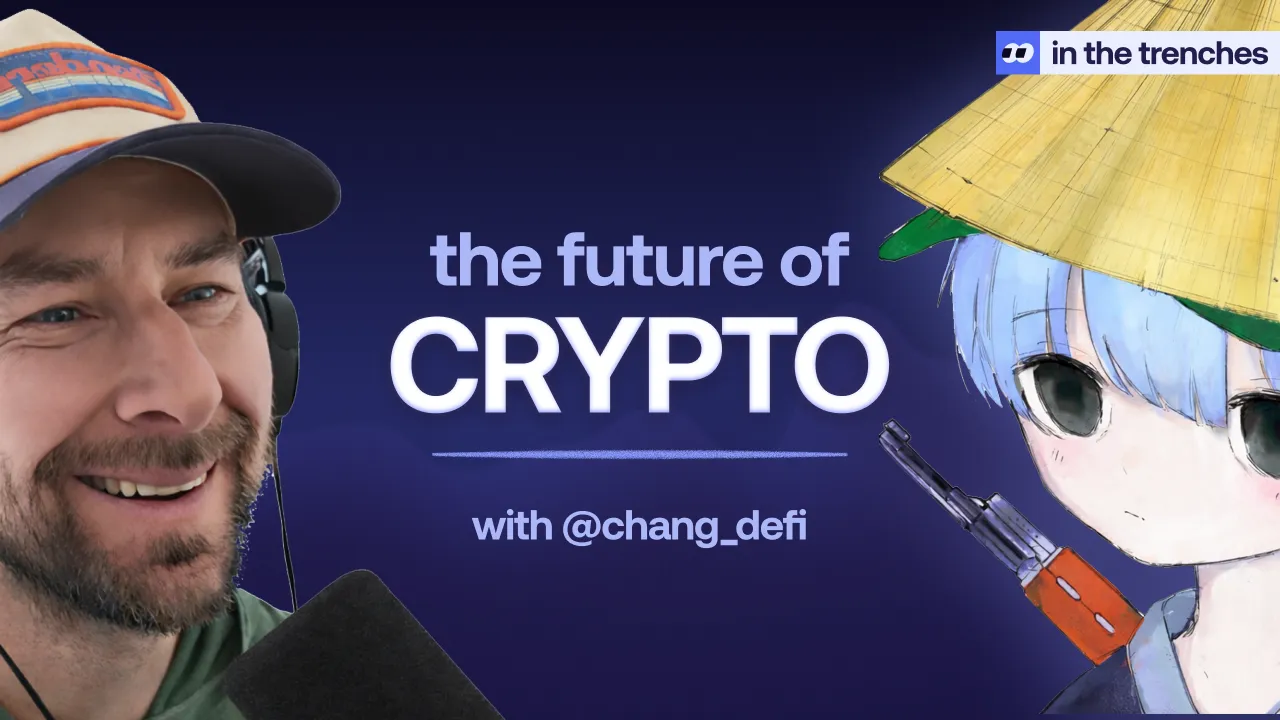
Robert Chang started trading crypto in 2021 with zero financial experience, no understanding of market cycles, and a habit of going all-in with leverage. Today, he is one of the more thoughtful voices in onchain trading, known on crypto Twitter as chang_defi. His journey from wiping out multiple times to building conviction-based plays and eyeing the next major crypto gaming meta is a story that every trader, whether brand new or battle-tested, can learn from.
In Episode 15 of the "In the Trenches" podcast, Chang sat down for an AMA-style conversation that ranged from early crypto trading mistakes to the psychology of tilt, the mechanics of developer-driven tokens, and a bold thesis on why web browser gaming could become the next massive crypto narrative.
Here is what he shared.
From Video Game Items to Crypto: An Unconventional Origin Story
Before Chang ever touched a trading chart, he was selling items in Team Fortress 2 and watching the economy shift in Counter-Strike. Those in-game economies planted an intuition he would not fully appreciate until years later.
"I sold a used cell phone or like some TF2 Team Fortress 2 hats to people for like in-game currency, but trading crypto was kind of like my first step into actually, you know, touching money."
The connection between digital item trading and crypto became most apparent during the NFT era. Unlike token charts, which abstract away the human element, NFTs on OpenSea made the marketplace feel physical.
"When you're trading NFTs, you literally feel like it's like trading those in-game items. And then you can really feel like you're being fleeced or you're fleecing someone else."
That visceral sense of who is on the other side of every trade carried over into onchain trading, where Chang learned to read participation and exhaustion in real time.
The Biggest Crypto Trading Mistakes: Going All-In and Gambling With Leverage
Chang is refreshingly honest about his early crypto trading mistakes. When he entered the market in 2021, he had no framework for risk management, and it showed.
"I've tried full porting leverage trading with my entire net worth. I've wiped out many times in the first year of trading."
His approach was not really trading at all. It was gambling.
"It just became like gambling in a lot of ways for me, which was kind of my biggest mistakes because you don't really know when you're going to make it back. You're kind of in the unknown a lot of times."
What Went Wrong Early On
Chang's early errors can be distilled into a few key patterns that many new crypto traders will recognize:
- Oversized positions with leverage - He would routinely put his entire net worth into a single leveraged trade, turning every position into a binary bet.
- No understanding of market cycles - Without any prior financial experience, he had no sense of when markets were overheated or when a correction was coming.
- Emotional greed spiraling into gambling - When profits came, instead of protecting them, he would feel greedy and gamble them away on more leverage.
- Sticking only to top-10 tokens - He would scroll CoinGecko and CoinMarketCap, only buying familiar names while ignoring the lower-cap opportunities where the asymmetric upside lived.
These are common crypto trading mistakes, but Chang's willingness to name them plainly makes the lesson hit harder.
Windfalls Over Consistency: The Uncomfortable Truth About Onchain Profits
One of the most striking admissions in the conversation is Chang's description of how he actually makes money. It is not the smooth equity curve that trading educators sell in courses.
"In terms of making money, it really is not a consistent thing for me. It's more like 90% of the time I'm unprofitable and once or twice or three times a year I just have this windfall of just money come in and it's like hitting a lottery."
This pattern, long stretches of losses punctuated by rare but massive wins, is something many onchain traders experience but few talk about openly. Chang attributes those windfall moments to a specific combination:
- Working with other people who bring ideas, energy, and execution
- Finding the right meta at the right time
- Genuine belief in the project or narrative
- Sensing energy in the market rather than relying on mechanical signals
"When that money comes, it's usually from a mix of working with other people, figuring out the right meta, believing in something."
When the market feels mechanical, with runners pumping but no organic energy behind them, Chang steps back. He waits for the moments when communities coalesce, ideas catch fire, and participation feels alive.
Reading Onchain Participation and Exhaustion
Chang's onchain trading strategy leans heavily on reading the crowd. Because crypto happens in public, with transparent wallets, leaderboards, and social feeds, you can literally see when a trade is getting crowded.
He tells the story of Monero Chan, a token he held a massive position in:
"The day that I saw that it was the top P&L on FOMO where everyone had that Monero Chan icon beside their name, I was like, this thing is gigatop. It's going to nuke for sure."
But he could not sell. He felt like "a Monero Chan guy," and selling would feel like betrayal. So he held while it dropped 80%, then finally sold at the bottom.
The Exhaustion Signal
The lesson is simple in theory but brutally hard to execute:
- When everyone in your feed is already holding the same token, there is nobody left to buy.
- When a token tops the public leaderboards, the trade is likely exhausted.
- When you feel emotionally tied to a position because of identity rather than analysis, you are in dangerous territory.
"When you see everyone's up so much on one thing, there's no one else in the space that can possibly buy, it's just over."
Chang treats onchain trading as a casino, and he is unapologetic about it. "I kind of look at it as a casino. I don't really think that unless the game itself changes drastically, it can't really not be a casino."
The WORM Saga: A Case Study in Conviction and Community
The most vivid story Chang tells is about a token called WORM. In late 2024, a friend in one of his group chats shared an idea. Someone else in the chat apparently took that idea, deployed a token with a 2D animation of a worm chasing an apple, and it started running.
Chang felt an emotional attachment because the concept originated with his friend. He went all-in.
"I put in 300k market bid at 8 to 10 million market cap and it nukes. It nukes to like 2 million or 1 million or 3 million somewhere around there. And I just don't give up on it."
What followed was a kind of creative psychosis. He recruited developers, rallied community members, and tried to "main character" the project. A back-end engineer from Hinge volunteered. Someone with a neuroscience PhD joined. They built a website, experimented with an AI agent in a TEE, launched a HyperEVM testnet.
None of the technology was groundbreaking. But the energy and belief attracted attention, including calls from partners at liquid funds and VCs.
"When you really really believe in something and you just keep pressing down on it and the environment is correct, it's really hard to fail."
The token eventually went to zero. But Chang views it as net positive. Multiple community members made significant money along the way. The experience taught him that in onchain markets, conviction paired with community can create value, even if it is temporary.
Developer Metas and the Creator Fee Revolution
Chang makes a sharp distinction between developers who extract and developers who build. Most token developers, he says, take the quick money.
"90% of times if you're a developer, you're launching a token or associating with it, you're probably looking to extract pretty quickly because you can make your annual salary very very quickly as a developer on these tokens."
But the creator fee model, where developers earn ongoing fees from trading activity on their tokens, is changing the calculus for a certain type of builder.
He points to the Monero Chan developer as an example:
"He was so surprised at how much he made in creator fees. He actually used over half for buybacks. I think he was really surprised how much he could make from creator fees that it made him quit his job."
What Makes a Developer Meta Work
For a developer-driven meta to truly succeed, Chang believes several ingredients are necessary:
- A main character - Someone willing to be the public face, carry the vision, and take reputational risk
- Ego - The developer needs enough ego to fight for the project, even when things go badly. "You need to have some ego. I don't think you can be an egoless person and just go provide wins onchain."
- Fresh faces - The crypto community gets fatigued by familiar names. New, authentic personalities inject energy.
- PvE dynamics - The best metas feel like players working together toward a shared goal, not just competing against each other.
The Next Big Meta: Why Web Gaming Could Explode
Perhaps the boldest claim Chang makes is about what comes next. He believes a crypto gaming meta is coming, even if the timing is uncertain.
"Web GPU is improving and it's getting adopted across these web browsers. And 3JS is like this kind of people are making games using 3JS. CT doesn't care about it. But really good games can be built and played at 120 FPS in your browser and they can all easily be connected to crypto."
Why Web Gaming Specifically
Chang lays out a multi-layered thesis:
- The tools have matured - WebGPU and 3JS make it possible to ship high-fidelity games that run entirely in the browser.
- Crypto and the web are already glued together - Unlike mobile or console, the web browser is where crypto wallets already live. Connecting money to gameplay is trivial.
- Hardware is catching up - The Steam Deck frame is coming out, and by 2027-2028, Apple AI glasses could open entirely new gaming surfaces.
- Talent is migrating - Paradigm fellows have left crypto to build games on Roblox. Y Combinator has funded a team trying to build the "Steam of the web."
- Existing platforms are fighting for developers - Fortnite is struggling to retain third-party developers against Roblox, creating an ecosystem battle reminiscent of Layer 1 blockchain competition.
"Once you take money and you glue it to a web browser experience, something will happen. I'm very very excited about this. It's going to be very very big."
He is currently working on a project called Lobby_WS, described as a game studio focused on web-based multiplayer gaming.
Memes as Digital Religions and In-Game Assets
When asked about the role of meme tokens in a gaming-centric future, Chang reframes them entirely.
"Memes are like IP or they could be like digital religions, clans, gang symbols. They could be anything."
He envisions meme tokens like Chill House transforming from simple cultural markers into in-game assets, character skins, or faction identities within gaming worlds. Communities built around meme tokens do not die easily, and when they persist, they can evolve into something more substantial.
"Once humans glue their attention to something and they do stuff, it's really hard for that idea to just die. And I think games can accelerate these symbols or visions into actual realities or experiences that people can spend time or money in."
This is a shift from memecoins as pure speculation to memecoins as community infrastructure, tokens that function as identity layers in richer digital environments.
Managing Tilt and the Psychology of Trading
When asked about managing tilt, Chang's answer is disarmingly simple.
"If I get tilted, I'm tilted. But the best thing to do is just look away, go outside, and just detach completely from everything. Eat food, talk to your wife. Go out for a walk. Just cope."
There is no elaborate system. No journaling protocol. Just human basics: step away, eat, walk, talk to someone who grounds you.
What He Still Struggles With
Chang admits that the biggest challenge he faces is getting too attached to ideas rather than processes.
"I feel like there's two sides of me at certain times that I need to utilize. I know that other side of me is perfect in trading, but it's not there all the time."
He describes a tension between the visionary side of himself, the part that gets emotionally invested in building something, and the detached trading side that can execute without sentiment. Balancing those two modes is an ongoing personal journey.
Starting from Zero: Get a Job Before You Trade
For aspiring traders, Chang's advice might be surprising. He does not suggest studying charts or paper trading. He suggests getting a job.
"If I start from zero, I would definitely focus on getting the highest paying job I could get rather than trading. But if I have interest in crypto, I would just get a job in crypto."
His reasoning is practical. A job provides income that cushions trading losses. More importantly, it connects you to people, ideas, and opportunities that trading alone never would.
"If you lost in trading, but you're building something real or you have some kind of career, then you feel a lot less like the starting from zero mentality."
He points out that being early to a crypto project, helping build it, and watching the valuation climb is itself a form of trading, just expressed differently.
"You can literally make money being in a project, raising money, being early to it, and watching the valuation go up. That's trading as well. That's not any different from buying and selling tokens."
On Asymmetric Trades and Staying in the Game
When pressed for the most asymmetric trade in crypto right now, Chang resists giving a simple answer.
"There's no true asymmetric trade. You have to see it for yourself and there's no way you can go out and define an asymmetric trade for another person."
Instead, he emphasizes that just keeping attention on crypto is itself valuable. The sectors to watch, he says, include AI, robotics, gaming, and metaverse-adjacent projects. But the specific expression of a trade depends entirely on the individual.
Key Takeaways from Robert Chang
For those looking to distill the conversation into actionable insights:
- Control position sizing ruthlessly. The number one crypto trading mistake is taking on too much risk, especially with leverage.
- Accept that profits come in bursts. Being unprofitable 90% of the time is normal if the windfalls are large enough. Survive between them.
- Read participation, not just price. When everyone you know is in the same trade, the upside is gone.
- Treat onchain trading as a casino. This is not cynicism. It is honesty about the game you are playing.
- Conviction plus community creates value. The best opportunities come from genuine belief backed by collaborative energy.
- Watch where developers are building. The next major meta will be visible in indie dev communities and tech infrastructure before it hits crypto Twitter.
- Get a job in crypto if starting from zero. Trading income is volatile. Career income is a foundation.
- Web gaming is the uncontested frontier. The infrastructure is ready, the talent is migrating, and the connection to crypto is native.